In brief
Munich runs two Wiesn a year, and most Americans have only heard of one. The Frühlingsfest, or Springfest, sets up on the same Theresienwiese every spring, and the 2026 edition runs April 17 to May 10, its 60th year and the first time it has stretched to three weeks. It has two tents instead of fourteen, and beer runs about a euro less a liter, €13.50 to €14.50 against Oktoberfest’s €14.80 to €15.90. Nobody reserves a table at the Frühlingsfest; every seat is first-come, where Oktoberfest has to write seating quotas into law to keep enough benches open for walk-ins. If your dates are flexible and a packed tent is not your idea of a good afternoon, this is the festival to book.
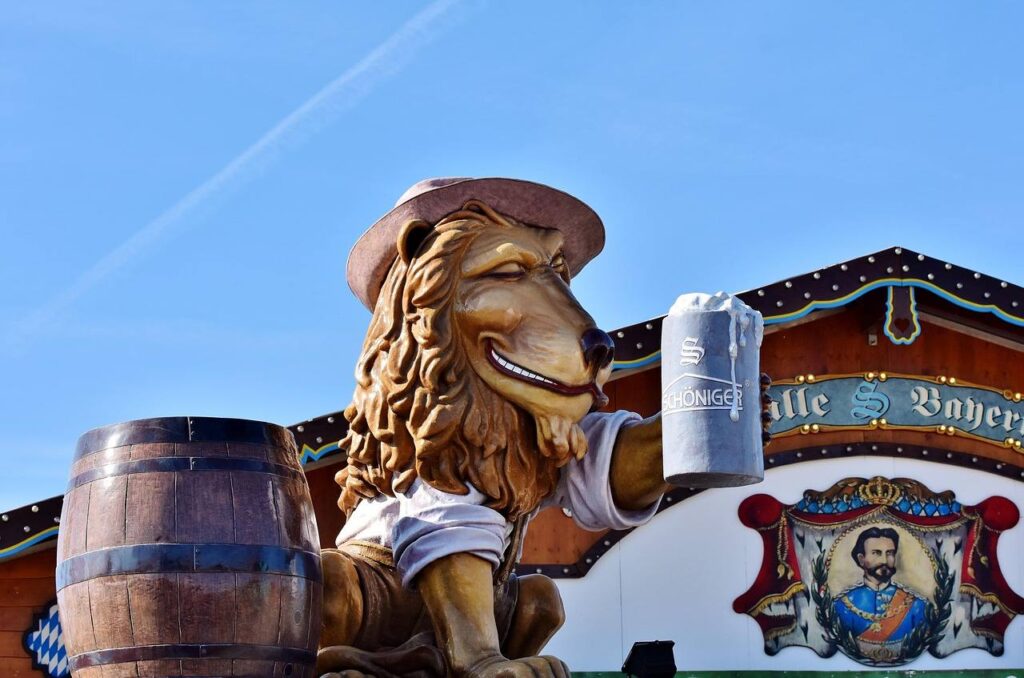
If you have only ever heard of the one Wiesn, here is what nobody mentions before you book: Munich holds two of them, and the smaller one lasts three weeks without a single person arguing about a reservation. The Frühlingsfest is Oktoberfest’s quieter cousin, on the same fairground every spring, and this page settles what is actually different between them: size, tents, beer, seating, and who each one suits. It is part of my Oktoberfest guide; if you have already picked the fall festival, the planning for it lives there.
I like the Frühlingsfest for a reason that has nothing to do with the beer. It is Oktoberfest with the stakes taken out: nobody is guarding a reservation card, nobody flew in from three time zones away for it, and the city does not need a published quota to keep the benches civilized.
What the Frühlingsfest actually is
The Frühlingsfest sets up on the Theresienwiese every spring, and the 2026 run is a bigger deal than usual: it is the 60th edition, and for the first time it stretches across three full weeks, April 17 to May 101. There are two beer tents, not fourteen: the Festhalle Bayernland pours Augustiner at €13.50 a liter, and the Hippodrom pours Spaten at €14.50, with both tents open to walk-ins the entire run1. Admission to the grounds and the tents is free, opening day starts with the traditional brewers’ entry at 4 p.m., and on the first Saturday the Bavarian Red Cross runs what the city calls Bavaria’s largest flea market, drawing thousands of vendors and visitors1. Rides and stalls run at reduced prices every Tuesday, noon to 7 p.m., which is about as close to an off-peak discount as a beer festival gets1.
The tents keep shorter hours than Oktoberfest’s do, too: Monday through Thursday they run 11 a.m. to 11 p.m., Friday until 11:30 p.m., and Saturdays, Sundays and May 1 open at 10 a.m.1. There is no equivalent of the Oide Wiesn’s brass bands and vintage rides here, and no costume parade; what you get instead is over a hundred carnival vendors and about thirty rides scattered around two tents, which is closer to a well-run county fair with excellent beer than to the spectacle Oktoberfest has become1.
Side by side: the numbers
The two festivals share a fairground and not much else in scale.
| Frühlingsfest 2026 | Oktoberfest 2026 | |
|---|---|---|
| Dates | April 17 – May 10 (24 days, the 60th year) | September 19 – October 4 (16 days) |
| Location | Theresienwiese | Theresienwiese |
| Tents | 2 (Festhalle Bayernland, Hippodrom) | 14 big tents, plus the small tents and the Oide Wiesn |
| Reservations | None; every seat is first-come | Required for evening tables in the main tents; a legal share of seats stays unreserved |
| Beer price | €13.50 (Augustiner) or €14.50 (Spaten) per liter | €14.80–€15.90 per liter, depending on tent |
| Admission | Free | Free |
| Crowd | Local and low-key; no visitor count is published | Large enough that the city writes seating rules into an ordinance |
Source: muenchen.de1; oktoberfest.de234.
Getting a table, or not needing one
At the Frühlingsfest, the whole reservation question does not come up. There is no booking system, no minimum spend, and no group of eight holding a card over your bench; you walk in, find a seat, and order1. Oktoberfest runs the opposite way: a quota law forces each tent to keep 25 percent of its seats unreserved on weekdays and 40 percent on weekends until 3 p.m., specifically because so many of the rest are booked months in advance by groups paying a minimum spend that averages around €350 for a table of eight to ten4. That single difference is most of what makes the Frühlingsfest feel like a different kind of day out, even though it is the same grounds and largely the same crowd of Münchners. The Oktoberfest minimum spend is not small either: a reserved table typically requires each guest to order at least two beers and half a roast chicken, on top of the table cost itself, which is exactly the kind of commitment the Frühlingsfest never asks of anyone4.
Who should pick which
Go to the Frühlingsfest if your trip dates are flexible, if you want a tent experience without any of the logistics, or if you are bringing kids and would rather not test them against an Oktoberfest evening crowd. It is also the better pick if the whole appeal of Oktoberfest, for you, was always “a Bavarian beer tent in spring weather” rather than the specific scale and spectacle of the Wiesn itself.
Go to Oktoberfest if the scale is the point: fourteen tents, the opening keg tap, the costume parades, and a festival big enough that Munich needs an ordinance to manage its seating. It costs a little more per liter and takes more planning, and for a lot of visitors that is exactly what they crossed an ocean for.
Resi says If I only had one week free and it happened to fall in April, I would take the Frühlingsfest without a second thought. Two tents, no reservation stress, and a beer that costs about what it should. Oktoberfest is the bigger show, and it earns the fuss, but it is also the version of this festival built for six-month planners, not for someone who just found a cheap flight.
Where to stay for either one
Because both festivals use the same grounds, the same neighborhoods work for both: the streets near Hackerbrücke and around Goetheplatz and Poccistraße put you a roughly ten-minute walk from the gates, whichever festival is running5. My guide to hotels near the Theresienwiese breaks the area down in more detail, and its logic holds for April as well as September. What does change is the pressure: I would not expect the Frühlingsfest to create anything like Oktoberfest’s demand on those same blocks, so booking the same neighborhoods in spring should come with a lot less urgency than it does in the fall.
Frequently Asked Questions
Is the Frühlingsfest the same as Oktoberfest?
No. It is a separate, smaller festival on the same Theresienwiese grounds every spring, with two tents instead of fourteen and no reservation system.
When is the Frühlingsfest 2026?
April 17 to May 10, 2026, the festival’s 60th year and its first three-week run.
Do you need a reservation for the Frühlingsfest?
No. Every seat is first-come, unlike Oktoberfest, where the main tents fill with reservation-holding groups in the evenings.
Is beer cheaper at the Frühlingsfest?
Yes, by about a euro a liter: €13.50 to €14.50 in 2026, against €14.80 to €15.90 at Oktoberfest.
Is the Frühlingsfest worth going to if I cannot make Oktoberfest?
If your goal was a Bavarian beer tent and a fairground atmosphere rather than the specific scale of Oktoberfest, yes.
Is the Frühlingsfest crowded?
It draws a real crowd, especially on the first Saturday’s flea market, but nothing close to what Oktoberfest’s fourteen tents pull in the fall.
Are there other Bavarian festivals like this one?
Several; my guide to Bavaria’s other volksfeste and my roundup of Bavaria’s other beer festivals cover the rest of the calendar.
Related Articles
 Oktoberfest in Munich: Dates, Tents, Reservations, What to Wear and What It CostsOktoberfest
 Oktoberfest Dates: 2026, 2027 and Why It Starts in SeptemberOktoberfest
 The Best Days and Hours to Go to OktoberfestOktoberfest
 Where to Stay for Oktoberfest: Hotels Within Walking Distance of the WiesnOktoberfest
 Missed Oktoberfest? Bavaria’s Other Volksfeste, from Straubing to ErlangenOktoberfest
 Bavaria’s Other Beer Festivals: Frühlingsfest, Bergkirchweih, Annafest and the GäubodenvolksfestBeer
 Oktoberfest in the US and Canada: The Big Ones, by RegionOktoberfest
 The Bavarian Year: Fasching to Christkindlmarkt, Month by MonthTrachten and customs
Sources
- Spring Festival Munich 2026 — muenchen.de, City of Munich. Accessed 2026-09-26.
- Oktoberfest — oktoberfest.de, City of Munich. Accessed 2026-09-24.
- Beer price — oktoberfest.de, City of Munich. Accessed 2026-09-24.
- Booking Oktoberfest: book a table — oktoberfest.de, City of Munich. Accessed 2026-09-24.
- How to get to Oktoberfest: routes, tickets, stations, apps — muenchen.de, City of Munich. Accessed 2026-09-26.