In brief
Ordering beer in Bavaria is mostly one word, “Bier,” or “eine Maß” if you want the full liter, said to whichever server passes your table first. Tipping is voluntary under German law, and the customary range at a restaurant is 5 to 10 percent, less on a large bill. Beer and wine cannot legally be sold to or drunk by anyone under 16, unless a parent or guardian is present. If you sit down at a table with a small reserved sign on it, you have probably just taken someone’s Stammtisch, a regulars’ table; the Hofbräuhaus am Platzl alone has more than 125 of them, with around 3,500 regulars sharing 616 personal mug compartments. And the last swallow you deliberately leave in the bottom of your Maß has a name too: the Noagerl.
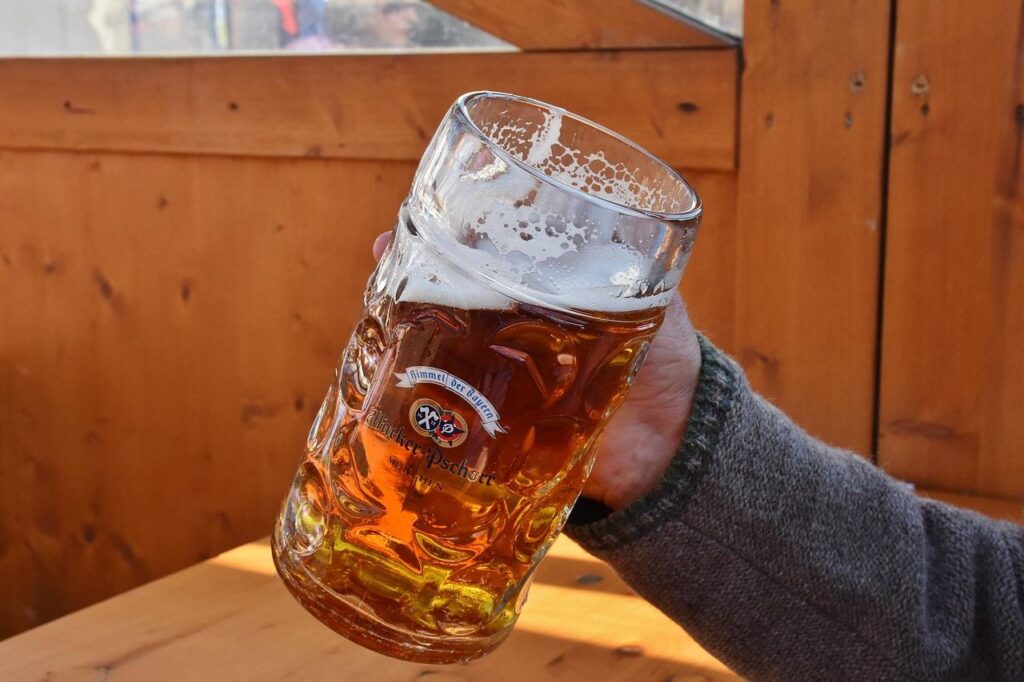
Nobody hands you a laminated beer menu in a Bavarian Gasthaus, and nobody expects you to know the vocabulary before you sit down, but knowing four or five words and one piece of table etiquette turns a confusing half hour into an ordinary one. Most of what trips visitors up is not the beer itself, which is usually a short list of one or two house styles, it is everything around it: what to call it, what to leave in the glass, how much to hand over at the end, and which empty-looking table is actually spoken for. My Bavarian beer guide covers what to actually drink; this page is about getting it to your table without an awkward pause.
Getting the server's attention, and the one word you need
There is no ceremony to it. You catch a server’s eye, and you say what you want: “Bier, bitte” gets you whatever the house pours by default, and “eine Maß” gets you the full liter, which most beer halls and beer gardens serve as their standard measure rather than an upsize. If you want a wheat beer specifically, “ein Weißbier” or “eine Weiße” works.
A handful of other words come up constantly on a Bavarian menu and around the table, straight from Munich’s own guide to the dialect: Brezn is the pretzel, never “Brezel”; Hendl is chicken, and a “Hoibs Hendl” is a half roast chicken, the classic Oktoberfest order; Brotzeit is a cold plate of bread, cold cuts and cheese; and An Guadn is what someone says to you before you eat, roughly “enjoy your meal”1.
| Word | What it means |
|---|---|
| Servus | Hello or goodbye |
| Griaß di / Griaß eich | Hello, to one person or several |
| Prost | Cheers |
| Gaudi | Fun |
| Wiesn | Oktoberfest, from Theresienwiese |
| Zefix | A mild curse, short for “Kruzifix” |
Source: Learn Bavarian Dialect, muenchen.de1.
The tip
Tipping in Germany is voluntary, with no legal obligation attached to it, but it is expected in the sense that almost everyone does it anyway. A German consumer-finance guide from Hanseatic Bank puts the customary restaurant range at 5 to 10 percent, trending toward the lower end on a bigger bill, and gives comparable figures for other services: 5 to 10 percent for a taxi, 10 to 15 percent for a hairdresser, a flat 2 to 5 euros for hotel room service, roughly 2 euros per bag for a hotel porter, and 50 cents to 2 euros for a coat check2. None of that is specific to a beer hall, but a beer hall server falls under the same restaurant-service norm as anywhere else you sit down to eat.
The practical version: round the bill up, or add something close to 10 percent if the service was good, and do not feel obligated to work out an exact percentage on the spot.
Resi says Nobody is going to chase you down over a euro either way. Tipping here is a small, ordinary courtesy, not the tightly choreographed math it can be in North America, and a beer hall server is not going to remember you badly for rounding to the nearest euro instead of calculating a precise ten percent.
Who can legally order one
Germany’s Jugendschutzgesetz, the youth protection law, sets the rule in its ninth paragraph: beer, wine and similar drinks cannot be sold to or consumed by anyone under 16 in a restaurant, a shop or in public generally, and that age limit does not apply if the minor is there with a parent or legal guardian. Spirits are stricter, off-limits to minors entirely regardless of who they are with. Alcohol vending machines are banned from public places unless they are inaccessible to minors, and any alcopop has to carry a printed warning label3. If a server asks for ID, that law is the reason, not suspicion aimed at you personally.
The Stammtisch: a table that is not for you
A Stammtisch is a regulars’ table, reserved by tradition rather than by a reservation system you can see, usually marked with a small sign or plaque that a first-time visitor can easily miss. It is not a formality. At the Hofbräuhaus am Platzl in Munich, more than 125 separate Stammtisch groups meet regularly, drawing roughly 3,500 regulars between them, and many of them keep a personal beer mug in a vault built for exactly that purpose, with 616 individual compartments reserved for regulars rather than available to buy into4. If you find an empty table with a sign like that on it, the simplest move is to ask a server, or just find a different table; it is somebody else’s evening, arriving later.
Resi says This is one of the small rules that actually matters, unlike some of the ones people make a fuss about. Sitting at an empty Stammtisch table is not a crime, but the regulars will know within about thirty seconds, and it is a bad way to start a meal.
The Noagerl: the sip nobody drinks
The Noagerl is the deliberate last bit of beer left at the bottom of the Maßkrug, the liter mug, and Munich’s own dialect guide defines it exactly that way: “the last bit left in the Maßkrug”1. Leaving it is not wasteful, it is closer to a small, understood ritual, a sign you have had enough without making an announcement of it. Nobody will refill a Maß that still has a Noagerl sitting in the bottom, and nobody expects you to explain why it is there.
Frequently Asked Questions
What do you say to order a beer in Bavaria?
“Bier, bitte” for a beer, or “eine Maß” if you want the standard one-liter mug rather than a smaller pour.
Do you have to tip in Germany?
No, tipping is voluntary with no legal requirement, but it is customary. Restaurants typically see 5 to 10 percent, less on a large bill.
What is a Stammtisch?
A regulars’ table, usually reserved by long tradition and marked with a small sign. Some Munich beer halls host well over a hundred separate Stammtisch groups, so an unmarked-looking table may still belong to one.
What does Noagerl mean?
The last small amount of beer deliberately left at the bottom of a Maß, a quiet way of signaling you have had enough.
What is the legal drinking age in Germany?
Sixteen for beer and wine, with an exception if a parent or guardian is present; spirits cannot be sold to or consumed by minors under any circumstance.
Is it rude to ask for a smaller beer than a Maß?
No. Many beer halls also serve a half-liter, and asking for one marks you as someone who wants to pace the evening, not someone breaking a rule.
Related Articles
 Bavarian Beer, Explained: Styles, Breweries, Beer Halls and Beer GardensBeer
 Bavarian Words for Visitors: Servus, Griaß Di, Prost and Twenty MoreTrachten and customs
 Bavarian Manners: Tipping, Quiet Hours, Sundays and PfandTrachten and customs
 Is the Hofbräuhaus Worth It? An Honest Look at Munich’s Most Famous Beer HallBeer
 Beer Hall or Beer Garden? How Munich’s Two Beer Cultures Differ and Which to PickBeer
 The Oktoberfest Dictionary: Wiesn, Maß, O’zapft is and 40 More WordsOktoberfest
 Drinking Age and Beer Laws in Germany: What Applies to VisitorsBeer
Sources
- Learn Bavarian Dialect — muenchen.de. Accessed September 2026.
- Kleiner Bonus, großer Bonus: Wie viel Trinkgeld ist richtig? — Hanseatic Bank. Accessed 2026-09-24.
- Jugendschutzgesetz §9 — Gesetze im Internet (German Federal Ministry of Justice). Accessed 2026-09-24 via Wayback Machine snapshot 2024-03-04.
- The Hofbräuhaus am Platzl — muenchen.de. Accessed 2026-09-26.