In brief
Bavaria calls itself the Freistaat Bayern, the Free State of Bavaria, a legal designation dating to 1918, when it moved away from monarchy. It covers about 70,550 square kilometers, the largest German state by area, and had a population of roughly 13.23 million as of June 30, 2026. It is divided into seven Regierungsbezirke, or administrative regions: Oberbayern, Niederbayern, Oberpfalz, Oberfranken, Mittelfranken, Unterfranken and Schwaben. Bavaria flies two flags of equal official standing, a white-and-blue striped flag and a white-and-blue lozenge flag with at least 21 diamonds, and its coat of arms carries a golden lion, a blue panther, a silver-and-red rake and three black lions, one for each historical region, plus the white-and-blue Wittelsbach lozenge shield representing the whole. And yes, Bavarians still have opinions about the rest of Germany.
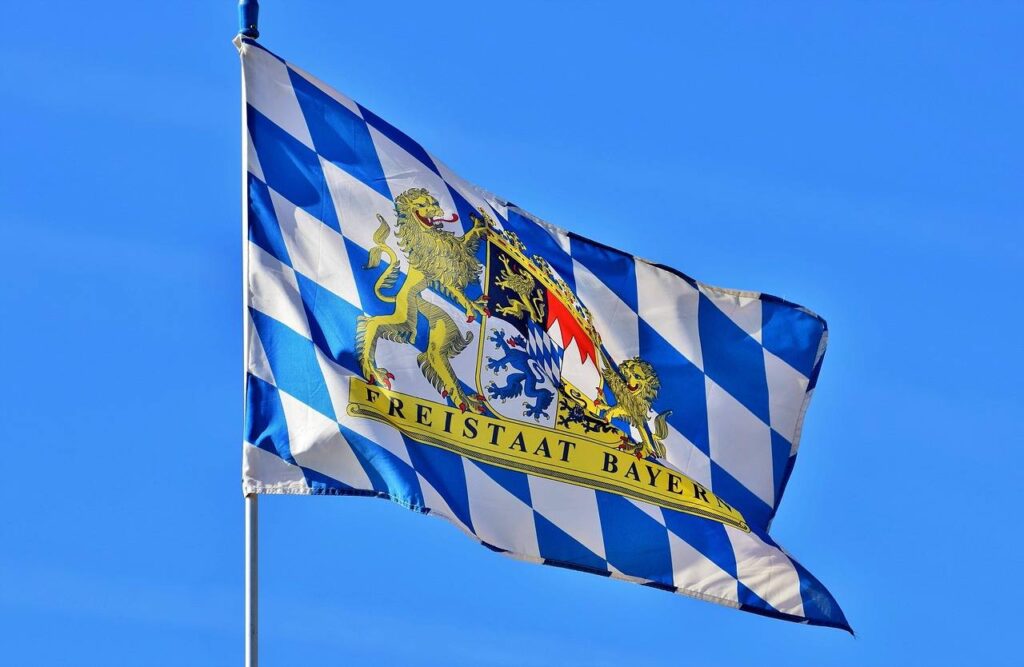
Ask most North Americans what a “typical German” thing is, and they will describe a dirndl, a stein of beer, a castle turret and possibly a cuckoo clock, all of which is really a description of Bavaria, and one of them is not even that. Sorting out what a Freistaat actually is, what is on that blue-and-white flag, and why Bavarians have a whole vocabulary for people from everywhere else in Germany, belongs on my Bavarian Trachten and customs page, and this is the deep dive.
What "Freistaat" actually means
Freistaat translates literally to “free state,” and it is not a marketing phrase. It is Bavaria’s own legal description of itself as a state within the Federal Republic of Germany, a designation that dates to Bavaria’s move away from monarchy in 19181. Several other German states use the same term for the same historical reason, so Bavaria is not unique in calling itself that, but it wears the label harder than the others do, and the name shows up on official letterhead, the state government’s own site, and in the way Bavarians talk about their own state’s standing.
It is worth being precise about what the word is not doing. “Free state” here is not a claim of independence from the rest of Germany; Bavaria remains a state within the Federal Republic. What it marks, per Bavaria’s own account, is the 1918 end of the Wittelsbach monarchy and the switch to a republican form of government under that same label1. The kings are gone; the label the change left behind stuck around, and Bavaria still uses it as of September 2026.
The basics: size, people, capital
Bavaria is the largest German state by area, at roughly 70,550 square kilometers, and Munich is its capital and the seat of the Bavarian State Chancellery1. Its population stood at about 13.23 million as of June 30, 2026, according to the Bavarian State Office for Statistics’s own figure2. That is a lot of ground and a lot of people to cover with one flag and one coat of arms, which is part of why both of Bavaria’s official symbols end up carrying so much regional detail rather than one simple emblem.
The seven regions
Bavaria is administratively divided into seven Regierungsbezirke: Oberbayern (Upper Bavaria, Munich’s own region), Niederbayern (Lower Bavaria), Oberpfalz (Upper Palatinate), Oberfranken (Upper Franconia), Mittelfranken (Middle Franconia), Unterfranken (Lower Franconia) and Schwaben (Swabia)1. The three Franconian regions and Swabia are historically and culturally distinct from what most visitors picture as “Bavarian,” which is a running theme on this whole page: a lot of what outsiders think is uniformly Bavarian is really specific to Oberbayern.
Almost everything a North American associates with Bavaria before ever visiting, the lederhosen, the beer tents, Neuschwanstein, is Oberbayern’s image exported to the rest of the world. That is not a complaint about the other six regions so much as an observation about which one has the better tourism marketing and the capital city. A trip that only sees Munich and the Alps south of it has seen one of seven Bavarias, and a genuinely good one, but not the whole state.
Two flags, one set of colors
Bavaria flies two flags with equal official status. The striped flag is horizontal white over blue; the lozenge flag is a field of white and blue diamonds, with at least 21 of them required in the official pattern3. White and blue are not just a color scheme picked for tourism brochures, either: the state colors are written into Article 1 of Bavaria’s own constitution3. If you see both versions of the flag flying in the same town and assumed one of them was wrong, neither is; the state genuinely maintains both.
The coat of arms, piece by piece
Bavaria’s state coat of arms was formally adopted on June 5, 1950, under the Law on the Coat of Arms of the Free State of Bavaria, and it is a small lesson in the state’s own history rather than a single simple symbol3. A golden lion on a black field, originally the symbol of the Palatinate Counts, now stands for the Oberpfalz region. A silver-and-red “Franconian Rake,” three white spikes on red-and-white fields, represents the three Franconian regions together. A blue panther stands for Lower and Upper Bavaria. Three black lions, drawn from old Hohenstaufen heraldry, represent Swabia. And at the center sits the lozenge shield itself, white and blue diamonds on a diagonal, which has been the Wittelsbach family’s own symbol since 1247 and represents Bavaria as a whole, topped by a “Volkskrone,” a people’s crown that first appeared in 1923 as a symbol of popular sovereignty rather than a royal one3. A simplified small coat of arms uses just the lozenge shield and the people’s crown.
Bavarians, and the rest of Germany
I am from the north of Germany myself, a “Nordlicht” in Bavarian eyes, so I have stood on both sides of this joke. Bavarians genuinely think rather highly of themselves compared to everyone else in the country, non-Bavarian Germans included, whom they collectively call “Preißn,” Prussians, whether your family has ever set foot in Prussia or not. It is mostly affectionate teasing, but I do think there is a grain of real feeling under it, and it is captured in a saying that sums up the whole attitude: it’s nice to be a Preiß, but it’s higher to be a Bayer. That attitude is a big part of why the “free state” label gets worn so proudly here, and it is also, I suspect, why more than a century after the monarchy ended, plenty of Bavarians still miss their king Ludwig.
Resi says Americans and other non-Germans routinely credit Bavaria’s dirndls, its castles and even the cuckoo clock to “Germany” in general, when all three are really Bavarian associations, and one of them isn’t even Bavarian at all: the cuckoo clock is from the Black Forest, which is nowhere near here. I mention it because it is the one mix-up that would make a Bavarian and a Black Forest local equally annoyed with you, for opposite reasons.
Frequently Asked Questions
What does Freistaat mean?
Free State. It is Bavaria’s own legal term for its status as a state within the Federal Republic of Germany, used since Bavaria moved away from monarchy in 1918.
How big is Bavaria?
About 70,550 square kilometers, making it the largest German state by land area.
What is Bavaria's population?
Roughly 13.23 million people, as of a June 30, 2026 count from the Bavarian State Office for Statistics.
What are Bavaria's seven regions called?
Oberbayern, Niederbayern, Oberpfalz, Oberfranken, Mittelfranken, Unterfranken and Schwaben.
Does Bavaria have more than one flag?
Yes. A white-and-blue striped flag and a white-and-blue lozenge (diamond) flag hold equal official status.
What is on Bavaria's coat of arms?
A golden lion for the Oberpfalz, a Franconian rake for the three Franconian regions, a blue panther for Lower and Upper Bavaria, three black lions for Swabia, and a central white-and-blue lozenge shield representing Bavaria as a whole, topped by a people’s crown.
Is Munich the capital of Bavaria?
Yes, and it is also the seat of the Bavarian State Chancellery.
Why do Bavarians call other Germans "Preißn"?
It is Bavarian slang for Prussians, used loosely for non-Bavarian Germans in general, usually in good-natured rivalry rather than literal geography.
Related Articles
 Dirndl, Lederhosen and the Bavarian Year: Trachten and Customs ExplainedTrachten and customs
 The Maibaum: Why Bavarian Villages Raise a Tree on May 1 and Steal Each Other’sTrachten and customs
 Almabtrieb and Viehscheid: When the Cows Come Down the MountainTrachten and customs
 Schuhplattler and Blasmusik: Bavaria’s Slap Dance and Brass BandsTrachten and customs
 The Bavarian Year: Fasching to Christkindlmarkt, Month by MonthTrachten and customs
 King Ludwig’s Castles: Neuschwanstein, Linderhof, Herrenchiemsee and Schachen, Now a UNESCO SiteBavaria
 Bavarian Beer, Explained: Styles, Breweries, Beer Halls and Beer GardensBeer
Sources
- Der Freistaat — bayern.de, Bavarian State Government. Accessed 2026-09-24.
- Bevölkerungsstand in Bayern — statistik.bayern.de, Bavarian State Office for Statistics. Accessed 2026-09-24.
- Bayern: Symbole — stmi.bayern.de, Bavarian State Ministry of the Interior. Accessed 2026-09-26.