In brief
The Fuggerei is a walled settlement inside Augsburg, founded in 1521 by the banker Jakob Fugger the Rich, and its own foundation describes it as the oldest existing social housing complex in the world. People still live there today, on terms tracing back to that 1521 founding, and the foundation calls it “unique in the world for 500 years”. Adult admission to the museum, bunker and a furnished display apartment is €8, and the site is open daily, 9 a.m. to 8 p.m. from April through September and 9 a.m. to 6 p.m. from October through March. Augsburg is also home to a newer UNESCO title, its Water Management System, recognized as a “City of Water”.
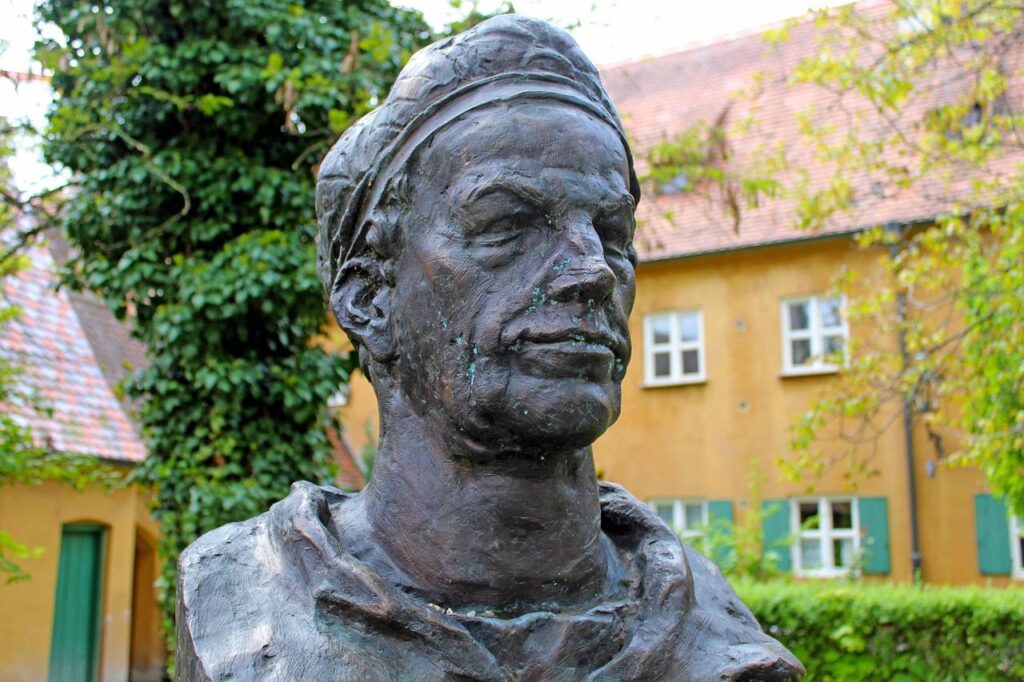
Augsburg tends to get treated as a stopover, the city you pass through on the way to somewhere else on the Romantic Road, and that undersells the one thing here that genuinely has no equivalent anywhere else in Bavaria: a five-hundred-year-old housing project that still houses people, on the same terms it always has, in the middle of a modern city. If you have room for exactly one stop in Augsburg, the Fuggerei is it, and everything else in town is a bonus.
What the Fuggerei actually is
Jakob Fugger the Rich, a banker, founded the Fuggerei in 1521 as a settlement for Augsburg’s working poor, and it has operated continuously ever since. The foundation that still runs it today describes the complex plainly, as “the oldest existing social housing complex in the world,” and frames its own age with a simple headline claim: “Unique in the world for 500 years”1. That is not a museum’s description of something it preserves; it is a working landlord’s description of a property it still manages, because the Fuggerei still houses residents on the original charitable terms, which is the detail that makes it more than a historical curiosity.
A visit covers three parts: the museum, an underground bunker built into the settlement during the Second World War, and a furnished display apartment set up to show how a Fuggerei resident actually lives. Adult admission is €8, and the site is open every day, 9 a.m. to 8 p.m. from April through September and 9 a.m. to 6 p.m. the rest of the year1.
Resi says Travel writers reach for the usual overused praise when they describe a small, underappreciated site like this one, and I would rather just tell you plainly: nothing this well documented and this openly promoted by its own city is actually a secret. What it is, genuinely, is unlike anything else on a Bavaria itinerary: a charity from the Reformation era that still does exactly the job it was built for.
Walking it
The Fuggerei reads, from outside its gates, like a village that got zipped into the middle of a city block: narrow lanes, small gabled cottages in a handful of repeated designs, and a quiet that the surrounding streets of Augsburg do not have. You can walk the public lanes for free and pay only to go into the museum, the bunker and the display apartment, which means a visitor deciding at the gate whether this is worth the detour can at least look before committing to the ticket. The bunker is the part most people do not expect: a shelter dug under the settlement during the Second World War, now open as part of the same visit, a reminder that a five-hundred-year-old charity has lived through the same history as everything around it rather than sitting outside of it.
The display apartment is furnished to show how residents actually live day to day, not staged as a period piece from 1521; the Fuggerei has been continuously inhabited and continuously updated across five centuries, and the apartment reflects that ongoing, lived-in reality rather than freezing the settlement at its founding. That distinction is worth sitting with for a moment: most of what a visitor sees on a Bavaria trip is preserved. This is maintained, for people who are living their actual lives in it right now.
The water city next door
Augsburg’s newer UNESCO recognition, its Water Management System, sits at the other end of the city’s identity from the Fuggerei’s charity: a network of canals, water towers and hydraulic works that kept the city functioning for centuries and earned its own separate World Heritage title under the banner “City of Water: now UNESCO world heritage”2. Pairing the two in one day gives you Augsburg’s two different claims to distinction, one social, one engineering, and between the Fuggerei’s cottage lanes and the water towers, a single day in Augsburg has enough to fill an afternoon without ever feeling like padding around the Romantic Road’s bigger names.
Getting there
Augsburg sits close enough to Munich that it works both as a standalone day trip and as a first or last stop on a longer Romantic Road itinerary or a Bavaria by train week. It is on Bavaria’s regional rail network, the same one covered by the Bayern-Ticket, Deutsche Bahn’s day pass for regional trains across the state, and it does not carry any of the timed-entry pressure that a Neuschwanstein or a Kaiserburg day does, since the Fuggerei’s own hours run into the evening on most of the year’s calendar.
Resi says Augsburg is the day trip I would build around a late afternoon rather than an early morning, precisely because the Fuggerei stays open until 8 p.m. for half the year. Sleep in, take a later train, and you still have hours of daylight left when you arrive.
Pairing it with the rest of a Bavaria trip
Augsburg’s position, close to Munich and at one end of the Romantic Road, makes it an easy add to a trip built around bigger names rather than a destination most people plan a whole day around from scratch. It works well tacked onto the start or end of a longer Romantic Road run toward Rothenburg and Würzburg, and it works just as well as a standalone afternoon out of Munich on a day when Neuschwanstein’s timed tickets did not fit your schedule. Either way, the Fuggerei is the part of the day that stays with you; the water towers and the old town streets around it are the part that rounds it out.
Frequently Asked Questions
Is the Fuggerei really the oldest social housing in the world?
Its own foundation describes it as “the oldest existing social housing complex in the world,” founded in 1521 and still housing residents today on its original charitable terms.
How much does it cost to visit the Fuggerei?
Adult admission is €8, covering the museum, a Second World War bunker and a furnished display apartment.
What are the Fuggerei's opening hours?
Daily, 9 a.m. to 8 p.m. from April through September, and 9 a.m. to 6 p.m. from October through March.
Do people still live in the Fuggerei today?
Yes, it continues to operate as housing under the same charitable model Jakob Fugger established in 1521.
Is Augsburg worth visiting beyond the Fuggerei?
Yes; its Water Management System, a network of historic canals and water towers, carries its own UNESCO World Heritage recognition.
How do you get from Munich to Augsburg without a car?
By regional train, covered by the Bayern-Ticket, Deutsche Bahn’s regional day pass for Bavaria.
Is Augsburg on the Romantic Road?
Yes, it is commonly used as a starting or ending point for a longer Romantic Road trip.
Related Articles
 Bavaria by Train: Day Trips from Munich and a Week Without a CarBavaria
 Romantic Road Itinerary: 2, 4 or 7 DaysBavaria
 Würzburg: The Residenz and Franconia’s WineBavaria
 Regensburg Day Trip from MunichBavaria
 The Bayern-Ticket: One Day of Regional Trains for a Group, ExplainedBavaria
 One Week in Bavaria by TrainBavaria
Sources
- Fuggerei: Info for Visitors — fugger.de, Fugger Foundations. Accessed 2026-09-27.
- Augsburg — augsburg-tourismus.de, City of Augsburg. Accessed 2026-09-27.