In brief
Bavaria has 622 operating breweries as of the most recent count, about 41.7 percent of every brewery in Germany, working out to roughly one brewing site for every 21,500 residents. Most of that density sits in Franconia, the northern third of the state: Oberfranken alone holds 170 breweries, more than a fifth of Bavaria’s total, in a region most Americans have never heard named. This is where Kellerbier is a way of life rather than a menu item, and where a handful of Oberpfalz towns still brew beer the way a co-op brews it, in a shared kettle, for whoever bought in.
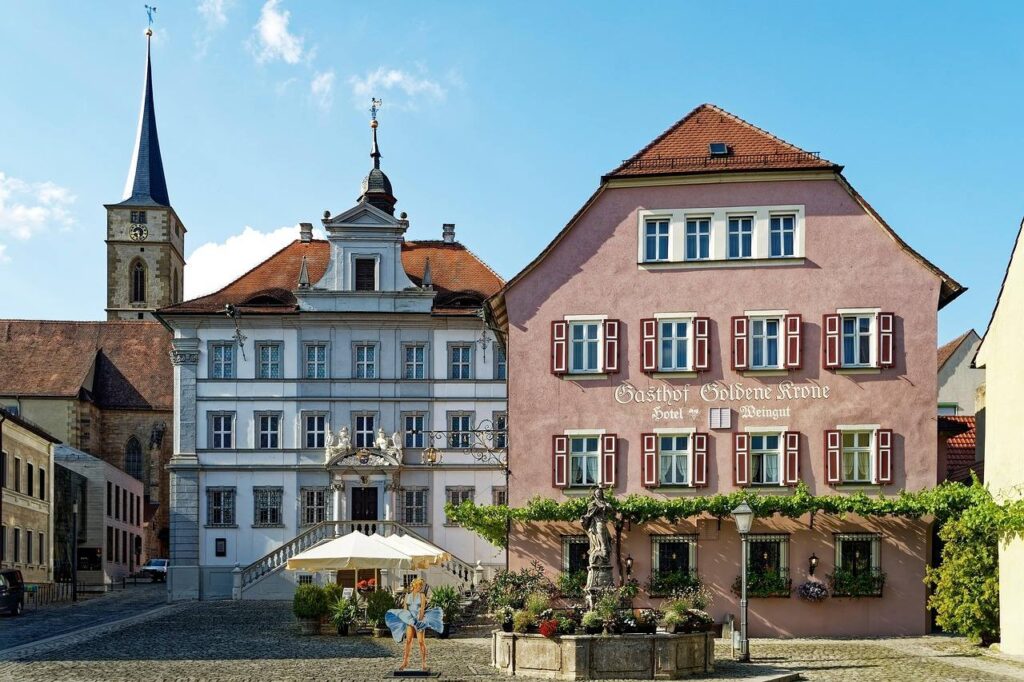
Most visitors’ idea of Bavarian beer country stops at Munich, which is a little like judging American wine by a trip to one Napa tasting room. The real density, the kind that gets cited in brewing statistics as unmatched anywhere else, is two hours north, in Franconia. This page is the numbers behind that claim, the two local traditions, Kellerbier and Zoigl, that explain what all those breweries are actually making, and where to base yourself if you want to go see it. It is part of my complete guide to Bavarian beer; if smoked beer specifically is what brought you this direction, the Bamberg Rauchbier guide covers that side of Franconia on its own.
The density, in numbers
Germany’s brewing industry lost sites almost every year through the pandemic, and Bavaria was not spared: the state’s count fell from a 2018 high of 654 to 622 by 2023, a net loss of 146 sites since 19931. What is left is still, by a wide margin, the densest brewing region in the country, and it did not get that way by accident; Franconia in particular has spent centuries treating a local brewery as a basic piece of civic infrastructure, closer to a well than to a business. The Bayerischer Brauerbund’s own regional breakdown, current to January 2024, shows exactly where those 622 breweries sit today.
| Region | Breweries | Share of Bavaria’s total |
|---|---|---|
| Oberfranken | 170 | 27.3% |
| Oberbayern | 138 | 22.2% |
| Schwaben | 79 | 12.7% |
| Niederbayern | 71 | 11.4% |
| Oberpfalz | 69 | 11.1% |
| Mittelfranken | 68 | 10.9% |
| Unterfranken | 60 | 9.6% |
Source: Bayerischer Brauerbund1.
Oberfranken, the region built around Bamberg, Bayreuth and Kulmbach, leads outright, and Oberpfalz, the region against the Czech border where Zoigl survives, holds its own 69 breweries despite being one of Bavaria’s less populated corners. Between them, those 622 breweries turn out more than 4,000 different beer brands across upward of 40 traditional styles, before you even count the craft segment layered on top2.
Counted as its own country, Bavaria’s beer output alone would rank around 15th in the world, ahead of most nations you could name, between Belgium and India3.
Kellerbier: the cellar, not just the beer
Long before mechanical refrigeration, brewers across southern Germany aged their summer beer in tunnels, caves and deep rock cellars, the Sommerbierkeller, to keep it cool through the warm months when brewing itself was too risky to attempt4. Unfiltered beer served straight from that kind of lagering cellar, cloudy, young and untouched by any further processing, is the direct ancestor of today’s Kellerbier, sometimes called Zwickl. In Franconia this did not stay a historical footnote; entire towns built their social life around sitting at long tables cut into a hillside, and many still do. One detail worth knowing before you repeat it to a bartender: the specific origin of the name “Zwickl,” often explained as coming from a cellar tasting valve called a Zwickelhahn, is widely repeated but was not confirmed on any brewery or brewing-authority page checked for this article, so it is left here as folklore rather than fact.
Resi says A Kellerbier is not a style so much as a serving method that became a culture: unfiltered, cold from a real cellar, and meant to be drunk sitting outside it. If a Franconian offers to take you to “the Keller,” that is an invitation, not a location, and you should say yes.
Zoigl: the beer the town brews together
The Oberpfalz Forest holds onto something rarer than a good cellar: a genuinely communal brewery. In Eslarn, Zoigl has been brewed for roughly 500 years, with the town securing its own Zoigl brewing right in 1522 and neighboring Neuhaus even earlier, in 1415. Five communities, Eslarn, Neuhaus, Falkenberg, Mitterteich and Windischeschenbach, still carry on the Kommunbier tradition today5. Here is how it actually works: “brewing citizens” pay into the shared kettle through a Kesselgeld, a kettle fee, then take their portion of the wort home to ferment and serve themselves, historically rotating the tavern role among their own living rooms. A household currently pouring marks its door with a Zoiglstern, a six-pointed star that looks like a Star of David, a besom broom, or a fir branch; the word Zoigl itself comes from the Lower Bavarian dialect for “to show,” zeigen, which is exactly what that sign is doing.
Eslarn’s current communal brewhouse, the Kommunbrauhaus, dates to 1900 on the site of an older manorial brewery, and now doubles as a small museum, the Biererlebnis Kommunbrauhaus. UNESCO named Zoigl an item of Intangible Cultural Heritage in 2018, and the tradition is still genuinely alive rather than preserved for show: about 18 Zoigl taverns serve the region today, and Eslarn alone has roughly 60 home and hobby brewers still using the communal kettle5.
Resi says Zoigl taverns do not keep predictable hours, because they are private homes taking a turn, not businesses. Look for the star on the door, and if a friend’s cousin’s coworker in Eslarn can point you to whoever is pouring this week, take the introduction over any list you find online.
Where to base yourself
Bamberg, in Oberfranken, is the obvious anchor: it sits inside the region with the most breweries in Bavaria, has a walkable UNESCO-listed old town, and puts Bayreuth and Kulmbach within easy day-trip range for anyone who wants to keep counting breweries as they go. For the Zoigl towns specifically, Eslarn and Windischeschenbach in the Oberpfalz Forest are small enough that you will not find international hotel chains there; look for a family-run guesthouse in either town rather than commuting in from a larger city, since the whole point of Zoigl is staying close enough to notice which door has the star lit up that particular week.
Resi says Split the trip: a base in Bamberg for the Rauchbier and the density of Oberfranken, then a night or two further out in the Oberpfalz Forest if the communal brewhouses are the part that actually pulled you here. Trying to day-trip Zoigl from Munich is a long way to go for a beer that might not be pouring when you arrive.
Frequently Asked Questions
Why does Franconia have so many breweries?
No single fetched source gives a definitive cause, but the region’s brewing statistics show Oberfranken alone holding 170 of Bavaria’s 622 breweries, the highest concentration in the state.
What is Kellerbier?
An unfiltered beer traditionally served straight from a cool lagering cellar, cloudy and young, that grew out of the pre-refrigeration practice of aging summer beer underground.
What does Zoigl mean?
It comes from the Lower Bavarian dialect word for “to show,” referring to the star, broom or fir branch a household hangs outside when it is its turn to pour the communally brewed beer.
Where can you drink Zoigl?
In five Oberpfalz Forest towns that still keep the tradition alive: Eslarn, Neuhaus, Falkenberg, Mitterteich and Windischeschenbach, at whichever private tavern is marked with the Zoiglstern that week.
Is Bavaria's brewery count still growing?
No. It has fallen most years since 2019, down to 622 by 2023, though Bavaria still holds close to 42 percent of all German breweries.
Is Zwickl the same as Kellerbier?
The terms are commonly used interchangeably for unfiltered, cellar-served beer, though the exact origin of the name Zwickl itself is not confirmed by any official source checked here.
Related Articles
 Bavarian Beer, Explained: Styles, Breweries, Beer Halls and Beer GardensBeer
 Bamberg’s Smoked Beer: Where to Drink Rauchbier and How to Get There from MunichBeer
 Weihenstephan, Weltenburg and the Oldest Brewery QuestionBeer
 Bavarian Beer Styles: Helles, Dunkel, Weißbier, Märzen, Bock and the RestBeer
 The Reinheitsgebot Explained: What the 1516 Purity Law Says and What It Means TodayBeer
 Bamberg Day Trip: The Old Town, Little Venice and the Beer, by Train from Munich or NurembergBavaria
 Würzburg: The Residenz and Franconia’s WineBavaria
Sources
- Die Brauereien — Bayerischer Brauerbund, national and regional brewery counts, via Wayback Machine snapshot 2024-11-04. Accessed 2026-09-24.
- Bayerisches Volksgetränk — Bayerischer Brauerbund, via Wayback Machine snapshot 2026-05-12. Accessed 2026-09-24.
- Die europäische Brauwirtschaft — Bayerischer Brauerbund, citing The Brewers of Europe, via Wayback Machine snapshot 2026-04-11. Accessed 2026-09-24.
- Eisgalgen — Bayerischer Brauerbund, via Wayback Machine snapshot 2023-10-04. Accessed 2026-09-24.
- Zoigl-Tradition in der Oberpfalz — Bayerischer Brauerbund, via Wayback Machine snapshot 2026-06-10. Accessed 2026-09-24.