In brief
The Englischer Garten is 376 hectares in the middle of Munich, laid out from 1789 as a public park and free to enter year-round. Its most photographed feature is not a building: the Eisbach wave, a standing wave on a park stream where surfers have ridden year-round since the practice was legalized in 2010, now under safety rules updated in November 2025 after a fatal accident, with permitted hours of 5:30 a.m. to 10 p.m., a mandatory buddy system, required self-releasing leashes and a minimum age of 14. The park’s other landmark is the Chinese Tower beer garden, a pagoda built in 1789 with seating for about 7,000. Both are a walk from each other, and both are worth building an afternoon around.
Every big city has a park; not every city has one with a permanent surf break running through it. The Englischer Garten does both jobs at once, a green space large enough to disappear into and a stage where you can watch a wave-riding subculture that has nothing to do with an ocean, and it does this two U-Bahn stops from the old town. It belongs on a first Munich trip even for visitors who have no interest in either the beer garden or the surfing, because it is simply the best place in the city to sit down outdoors.
How big it actually is
The park covers 376 hectares, split roughly into 187 hectares of meadow, 170 of woodland and 16 of water, laid out from 1789 for Elector Karl Theodor with Sir Benjamin Thompson, Count Rumford, and the landscape architect Friedrich Ludwig von Sckell1. It draws more than five million visitors a year across 78 kilometers of paths and over a hundred bridges, and none of that traffic makes it feel crowded, because there is simply enough park to absorb it1. Bring the idea of a destination and let it go; the point of the Englischer Garten is walking into it without a plan.
The Monopteros, the park's quiet landmark
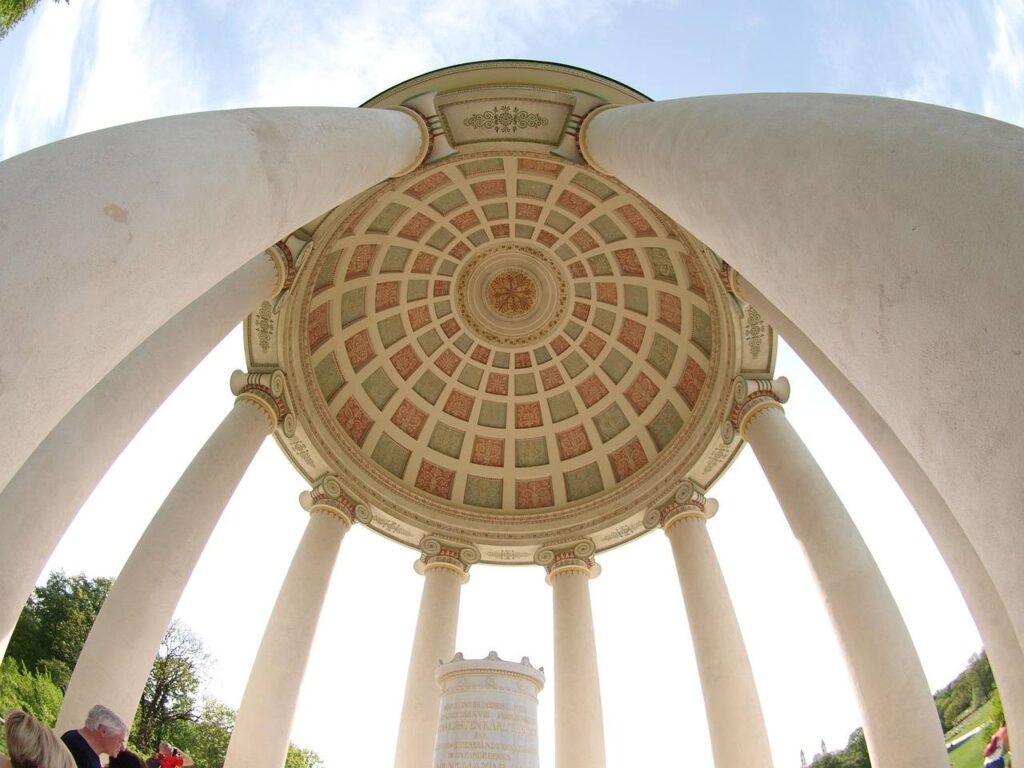
Between the two better-known attractions sits a smaller one most visitors walk past: the Monopteros, a small round Greek temple built in 1836 and 1837 on an artificial hill, with a view south over the meadows that makes it the best free lookout point in the park1. It has none of the crowd of the beer gardens and none of the spectacle of the wave, which is exactly why it is worth the five-minute climb; a lot of Munich’s own residents treat it as the park’s actual center.
The Eisbach wave and its surfers
At the park’s southern edge, where the Eisbach stream passes under a bridge near Prinzregentenstraße, the water forms a standing wave that a wetsuited crowd has surfed continuously since the city legalized it under then-mayor Christian Ude in 20102. It looks improvised and is not: after a fatal accident in April 2025, the rules were tightened as of November 2025, and surfing is now permitted only between 5:30 a.m. and 10 p.m., with a mandatory buddy system, required self-releasing leashes, a minimum age of 14, and new floodlights installed for the hours near dawn and dusk2. The best places to watch are the Eisbach bridge itself and the banks nearby, at the park’s southern entrance2.
You do not need to surf to make this worth the walk. A line of spectators along the railing at almost any hour is normal, and the wave runs regardless of the weather, which is not something you can say about most of what else Munich has to offer in February.
Resi says Watch from the bridge, not the bank directly beside the wave; the surfers need the space, and the bridge gives you the better angle on the whole thing anyway.
The Chinese Tower beer garden
A ten-minute walk north brings you to the Chinesischer Turm, a 25-meter pagoda built in 1789 that anchors one of Bavaria’s largest beer gardens, with seating for about 7,000 people, a brass band and a historic carousel nearby1. This is the classic version of a Munich beer garden: long communal tables, a self-service line for food, and the option to bring your own if you would rather. If a Radler is more your speed than a straight beer, order one; it is half beer and half lemon soda, costs and pours the same as a full Maß, and looks identical from across the table.
For a quieter version of the same idea, the Seehaus at the Kleinhesseloher See, a lake within the park, runs a beer garden daily from 10 a.m. to 1 a.m. with roughly 2,500 seats, and a rowing or pedal boat is available to rent nearby on nice-weather summer days, generally into the evening3. It sits between the Chinese Tower and the park’s northern edge, so either one can anchor a walk depending on which direction you are coming from.
Seeing it by bike
The park is large enough that a bike genuinely changes what you can cover in a morning, and a guided ride solves the route-planning problem while adding the Eisbach wave and a beer garden stop into one outing; I earn a commission on this one. The Munich Classic Bike Tour, a late-morning ride of three to four hours, includes a stop at the Eisbach surfers and a beer garden along the way, priced from $41, rated 4.9 stars from 1,387 reviews as of September 20264. It covers more of the park in three hours than most visitors manage on foot in a full day, and it hands you the context for what you are watching at the wave rather than leaving you to guess.
Getting there
The park has multiple entrances rather than one main gate, so where you enter depends on what you came for. For the Eisbach wave, the closest entrance is the park’s southern one, near Prinzregentenstraße 12. The Chinese Tower sits further north, roughly the middle of the park, and reaching it means committing to a real walk through the meadows rather than a quick detour. There is no single ticket, no closing time posted at a gate, and no reason to plan the visit around a schedule the way you would for a museum.
Frequently Asked Questions
Can anyone surf the Eisbach wave?
Only experienced surfers should attempt it; the current is strong and the new rules require a buddy, a self-releasing leash and a minimum age of 14. Watching from the bridge is the right choice for everyone else.
How big is the Englischer Garten?
376 hectares, split roughly into meadow, woodland and water, with 78 kilometers of paths running through it.
Can you bring your own food to the Chinese Tower beer garden?
Yes. Munich beer gardens allow visitors to bring their own food, as long as you buy your drinks from the garden itself.
Is the Englischer Garten free to enter?
Yes, the park is free and open year-round with no gates or admission.
When do the Eisbach surfers ride?
Surfing is permitted from 5:30 a.m. to 10 p.m. under the rules updated in November 2025, though the wave itself is watched at almost any hour.
Is the Englischer Garten safe at night?
The park is large and unevenly lit outside its main paths; the beer gardens and the Eisbach viewing area are well used into the evening, but a solo walk through the darker meadows after closing hours is not the same experience as a daytime visit.
Related Articles
 Munich for a First Trip: What Is Worth It, What Is Not, and How the City WorksMunich
 Munich Beer Garden Rules: Bring Your Own Food, Never Your Own BeerBeer
 Radler vs Shandy: Bavaria’s Cyclist’s Beer and How to Mix ItBeer
 Bavarian Beer, Explained: Styles, Breweries, Beer Halls and Beer GardensBeer
 Beer Hall or Beer Garden? How Munich’s Two Beer Cultures Differ and Which to PickBeer
 What to Eat in Munich: 15 Dishes and Where the City Eats ThemMunich
 Munich with Kids: The Zoo, the Deutsches Museum, the Beer Gardens with PlaygroundsMunich
Sources
- English Garden — muenchen.de, City of Munich. Accessed 2026-09-24.
- Eisbachwelle: Munich’s Eisbach surfers in the city — Englischer Garten München Infos. Accessed 2026-09-24.
- Seehaus — Kuffler Gastronomie, quoted via search summary. Accessed 2026-09-27.
- Munich Classic Bike Tour — Viator. Accessed 2026-09-27.