In brief
Munich does not have one signature dish, it has a rotation, and a first-time visitor who orders the same three things at every Wirtshaus is missing most of it. The fifteen below cover breakfast, the market stall, the beer-hall plate and the pastry counter, each with the kind of place that actually serves it well. Some belong at a specific address: Schneider Bräuhaus on the Tal has served Weißwurst since 1872, poached and brought to the table in its own tureen with a pretzel and sweet mustard. Others belong at a kind of place, a Brotzeit board at the Viktualienmarkt or a bench in a beer garden, which this guide points you to as well.
Disclosure: some links on this page are affiliate links, marked by the products, tours and hotels they name. As an Amazon Associate, bavarianbistro.com earns from qualifying purchases. A purchase through these links may earn the site a commission at no cost to you, and it never affects what is recommended. How this works.
If you land in Munich hungry and order the first thing on an English menu, you will probably get Schnitzel, which is Austrian by claim and available everywhere on earth. That is not why you flew here. This is a city with an actual eating schedule, dishes tied to a time of day, a kind of room and, in a few cases, a specific address that does it best, and knowing which is which turns a meal into the thing you remember instead of the thing you photographed. It is part of my Munich first-trip guide, which covers the rest of the city; this page is only the food.
The pattern underneath all fifteen dishes is the same: Bavarian cooking is built for beer, for long lunches, and for using every part of the pig. Once you see that, the menu stops being a wall of German words and starts making sense.
Breakfast: Weißwurst, and nowhere else
Weißwurst is a Munich dish with a curfew: it was traditionally eaten only in the morning, before the noon bells, back when there was no refrigeration to trust it past that. Schneider Bräuhaus, in the Tal since long before that rule made any modern sense, still runs a dedicated Weisswurstfrühstück daily from 9 a.m. to noon, and a Sunday and holiday Frühschoppen from 10:30 to 1, with the sausage poached and served the traditional way, a pretzel and sweet mustard alongside, and the house’s own Schneider Weisse wheat beer to drink it with1. My full guide to eating Weißwurst covers the skinning technique nobody explains to you in advance and the mustard rule that actually matters.
The market lunch: Viktualienmarkt, Obazda and the fresh Brezn
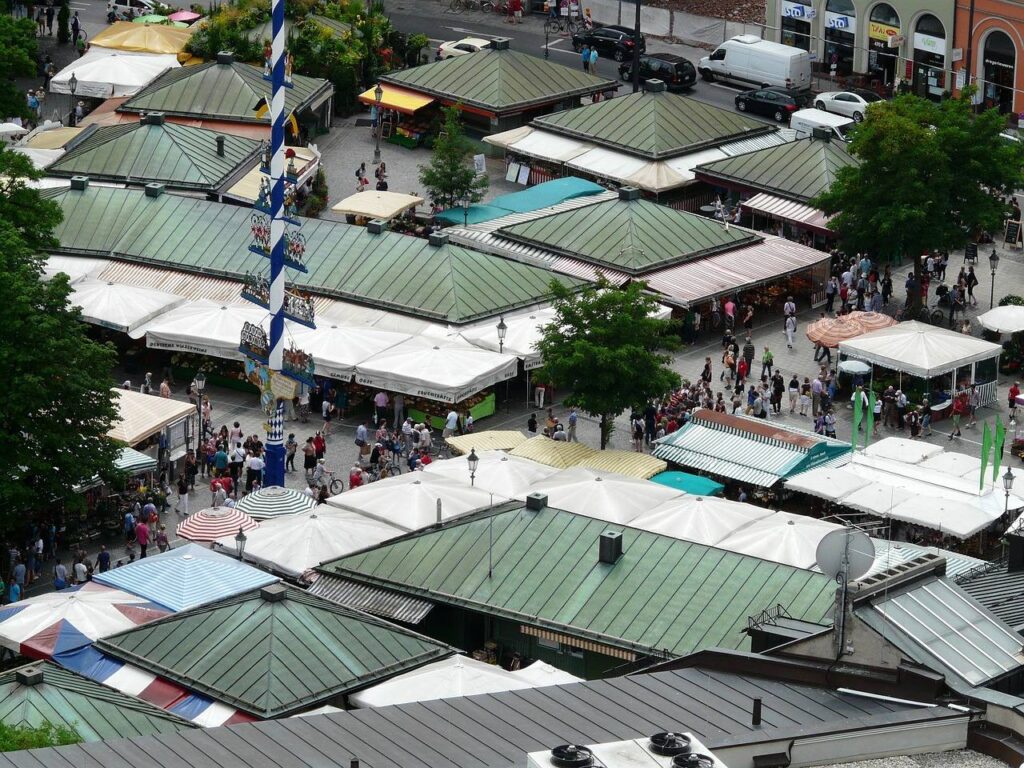
Munich’s food market is not a museum piece; it is where the city buys lunch. The stalls run Monday to Saturday, roughly 8 a.m. to 8 p.m., and the beer garden at its center pours a different one of Munich’s six major breweries every five to six weeks, so the beer itself tells you what month it is2. Visitors are welcome to bring their own food to the tables, which is the market’s whole culture in one rule.
This is where Obazda belongs: a creamy spread worked from ripe camembert and butter, spooned onto a Brezn from one of the market’s bakery stalls. My Obazda guide has the recipe if you want to make it at home, and the pretzel piece explains why the crust tastes like nothing else in a North American bakery case. Add a paper cone of Auszogne, the market’s fried-dough pastry, from one of the stalls that specializes in it, and you have covered breakfast, lunch and dessert without sitting down once; the full case for the pastry is on my Auszogne and Schmalznudel page.
Resi says Of course the fresh Brez’n and the Obazda, a creamy cheese made from camembert and butter, were always on my list. And I could always count on a heavenly Leberkäs Semmel with sweet mustard, the original Bavarian fast food, whenever I got hungry during an errand run. The Händlmaier mustard, by the way, is so good I could eat it by itself — nothing compares, and it’s always a favorite when I bring it to a camping trip.
The stand-up lunch: Leberkäs Semmel and the Rostbratwürstl
If the Brotzeit board is Munich’s sit-down lunch, the Leberkäs Semmel is its lunch on the move: a warm slice of Leberkäse, which despite the name has neither liver nor cheese in it, pressed into a fresh roll with sweet mustard, sold from a butcher’s counter or a stand-up Imbiss. My Leberkäse page explains exactly what is in the loaf, since the name is the most misleading in Bavarian food.
The Rostbratwürstl, small pan-fried pork sausages about the size of a finger, belongs to the same category of food you eat standing at a Brotzeit table, usually a half-dozen to a plate with sweet mustard and horseradish. The full page on Nürnberger Rostbratwurst covers the EU-protected version from Nuremberg, which is what most Munich kitchens are actually serving under that name.
The Wirtshaus plate: Schweinshaxe and Schweinebraten
For the sit-down, knife-and-fork meal, Munich has two pork roasts and a real distinction between them. Schweinshaxe is the whole pork knuckle, roasted until the skin cracks like glass, and the Hofbräuhaus on the Platzl serves it daily from 11 a.m. with its kitchen open until 10 p.m., in a room built for exactly this kind of eating3. My Schweinshaxe page has the technique for the crackling, and whether the Hofbräuhaus itself is worth the trip is its own honest answer.
Schweinebraten is the everyday version: a boneless pork roast, sliced, under a dark-beer gravy, with a Semmelknödel or potato dumpling on the side, the dish a Munich family actually cooks on a Sunday rather than orders on vacation. The Schweinebraten page has the gravy.
From the beer garden: Wiesn Hendl and Steckerlfisch
A beer garden kitchen sells two things that do not survive being reheated: half a roast chicken, the Wiesn Hendl, crisp-skinned and served with your hands, and Steckerlfisch, a whole fish, usually a mackerel or trout, butterflied and grilled slowly on a wooden stick over an open fire until the skin blisters. Both are built for eating outdoors, at a long shared table, with a Maß in front of you and no cutlery you actually need. The Wiesn Hendl page and the Steckerlfisch page have the full case for each, and my beer garden rules cover what you are and are not allowed to bring to the table alongside them.
The side that is not a side: Bavarian potato salad
Munich’s potato salad has nothing to do with the mayonnaise version most North Americans grew up with: it is dressed warm, in vinegar and broth, and served alongside a Schweinshaxe or a Schweinebraten rather than at a picnic. The full potato salad page has the ratio that keeps it from turning gluey, and it is worth ordering once specifically to notice what is missing from the bowl.
Dessert: Kaiserschmarrn and Dampfnudel
Munich’s two big sweet plates both take twenty minutes to cook to order, which is your cue to order them before you order your main course, not after. Kaiserschmarrn is a torn, caramelized pancake, dusted with sugar and served with stewed plums or applesauce; the full page has its Austrian backstory and how Bavaria made it its own. Dampfnudel is a yeast dumpling steamed in milk until the bottom caramelizes and the top stays soft, usually with a vanilla sauce; the Dampfnudel page has the pan technique that decides whether it works.
If you would rather have someone walk you through it
A guided food walk solves the ordering problem entirely, and I earn a commission on this one. The Munich Old Town Food Tour with 10+ Bavarian Specialties & Beers runs 3.5 hours through the old town with a guide, rated 4.9 stars from 429 reviews, priced from $116 with the exact figure depending on group size, free cancellation, and flagged as likely to sell out as of September 20264. It will not replace this page, since it moves through a set list rather than the fifteen above, but it solves the single hardest part of eating in Munich on a short trip, which is knowing what to order before the menu is in your hands. My Munich food tours compared page lines this one up against five others if you want to see the field before booking.
Resi says Check a stall or restaurant’s own hours before you build a morning around it; a Weißwurst breakfast that ends at noon has ended by the time some visitors are done with their coffee. Build the food day around the dish, not the other way around.
Frequently Asked Questions
What is the most Bavarian dish to try in Munich?
Weißwurst, eaten before noon, is the dish most tied to the city itself, and Schneider Bräuhaus on the Tal has served it that way since 1872.
Is Bavarian food the same as German food?
No. Bavarian cooking leans on pork, beer and dumplings in ways that differ from northern German cooking, and my page on the difference lays out the specifics.
What should I eat at the Viktualienmarkt?
Obazda on a fresh Brezn, or a Leberkäs Semmel from one of the stalls, eaten standing at a Brotzeit table with a beer from whichever brewery is pouring that month.
Do I need a reservation to eat at the Hofbräuhaus?
No, not for an individual or a small group on the ground floor; groups of four or more should reserve ahead.
What is the difference between Schweinshaxe and Schweinebraten?
Schweinshaxe is the whole roasted pork knuckle with cracked skin; Schweinebraten is a sliced, boneless pork roast under a dark-beer gravy. Order the Haxe for the spectacle and the Braten for the everyday version.
Is Bavarian potato salad served cold?
No. It is dressed warm, in vinegar and broth rather than mayonnaise, and usually sits beside a roast rather than on its own plate.
What is a good vegetarian option in Munich?
Kaiserschmarrn and Dampfnudel are both meat-free and widely available as full plates, not just desserts, and Obazda on a pretzel makes a vegetarian lunch on its own.
Related Articles
 Munich for a First Trip: What Is Worth It, What Is Not, and How the City WorksMunich
 The Viktualienmarkt: Munich’s Food Market and Its Beer GardenMunich
 Munich Food Tours Compared: What Each One Feeds You and What It CostsMunich
 Bavarian Food: The Dishes, How Munich Eats Them, and What to Cook at HomeFood
 How to Read a Bavarian Menu: 60 Words from Brezn to ZwetschgendatschiFood
 Is the Hofbräuhaus Worth It? An Honest Look at Munich’s Most Famous Beer HallBeer
 Munich Beer Garden Rules: Bring Your Own Food, Never Your Own BeerBeer
 Brotzeit: Bavaria’s Bread-Time Meal, and What Goes on the BoardFood
Sources
- Unsere Speisen — Schneider Bräuhaus, quoted via search summary. Accessed 2026-09-27.
- Opening hours — Viktualienmarkt. Accessed 2026-09-24.
- Hofbräuhaus München — Hofbräuhaus München. Accessed 2026-09-24.
- Munich Old Town Food Tour with 10+ Bavarian Specialties & Beers — Viator. Accessed 2026-09-27.