In brief
Munich hotel rooms during Oktoberfest are not the bargain they are the rest of the year, and one honest workaround is to not sleep in Munich at all. Augsburg, half an hour or so up the line by regional train, is Bavaria’s third-largest city and the home of the Fuggerei, described by the city’s own tourism site as the oldest social housing settlement still in use in the world. A group of up to five travelers can cover a full day of regional trains anywhere in Bavaria on a single Bayern-Ticket, which starts at €34 for one person and adds each additional traveler for €10, with up to three children six to fourteen riding along free. The one rule that makes or breaks a day trip is arrival at the Theresienwiese itself: there is no parking anywhere near the grounds, and the festival’s own site says so in as many words. This page is the case for basing outside Munich and coming in for the day.
Disclosure: some links on this page are affiliate links, marked by the products, tours and hotels they name. A purchase through these links may earn the site a commission at no cost to you, and it never affects what is recommended. How this works.
Where to book Current rates in the nearest big town on the Munich rail line.
Everyone assumes Oktoberfest means a Munich hotel room, and for a lot of visitors that assumption is what makes the trip expensive. It does not have to. Munich sits inside one of the densest regional rail networks in Germany, and a day trip in for the tents, out again at night, is a completely normal way to do this. This page is part of my Oktoberfest guide, and it makes the case for Augsburg and the countryside as a base, with the actual transit rules that make it work.
Why hotel rooms near the grounds get harder to find
I am not going to hand you a specific nightly rate for a Munich hotel during Oktoberfest, because I could not find one on a source I trust enough to print. What is not in dispute is the basic mechanic: a festival that fills the city with visitors for over two weeks puts pressure on every hotel room within walking distance of the grounds, and that pressure is highest on weekends and lowest midweek. If a Munich hotel search during the festival looks expensive compared to what the same room costs in June, that is Oktoberfest doing exactly what a sold-out event does to the rooms nearest it. A day trip sidesteps the problem entirely, because you are pricing hotel rooms in a city that is not hosting the festival.
Augsburg: close enough, and worth the day on its own
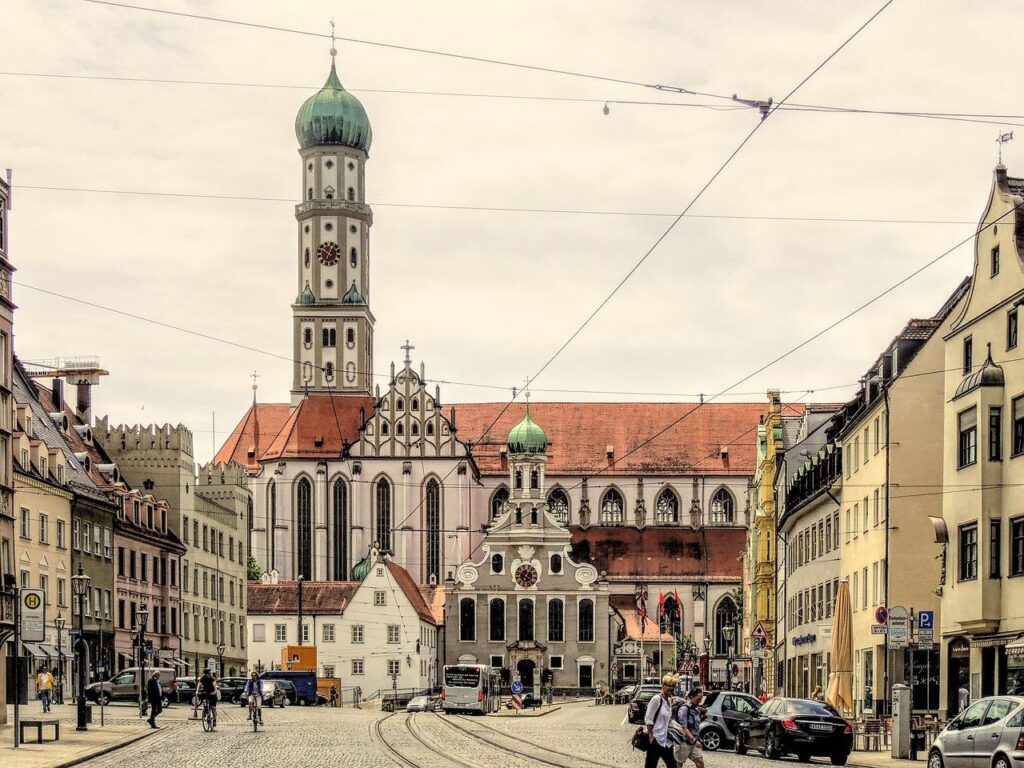
Augsburg is one of Germany’s oldest cities and Bavaria’s third-largest, and it earns a day trip even without Oktoberfest as an excuse. Its best-known attraction is the Fuggerei, which the city’s tourism site calls “the oldest social settlement in the world,” founded by the banker Jacob Fugger the Rich, and its historic water-management system of canals and towers has been newly recognized as a UNESCO World Heritage site under the label “City of Water”1. Between the Fuggerei’s cottage lanes and the UNESCO water towers, it is a full morning or afternoon on its own, which is the actual case for staying there: you are not settling for a cheaper bed, you are picking a second city that happens to be a short regional-train ride from the festival.
I could not confirm an exact Munich-to-Augsburg train travel time on any of the sites I am allowed to cite for this page, so I am not going to print a number I have not seen stated outright. What I can tell you is that Augsburg sits on Bavaria’s regional and S-Bahn network and is covered by the Bayern-Ticket described below, which is the detail that actually matters for planning the day2.
The Bayern-Ticket: one ticket for the whole group, the whole day
If you are traveling with even one other person, the Bayern-Ticket is the thing to buy before you buy anything else. It covers local trains, S-Bahn, U-Bahn, trams and buses across almost all of Bavaria, for up to five people traveling together, with up to three children aged six to fourteen riding along free on top of that2. Second-class pricing for 2026 runs €34 for one traveler, €44 for two, €55 for three, €64 for four and €74 for five; first class runs from €46.50 up to €134.50 at the same group sizes2. On a weekday, it is valid from 9 a.m. to 3 a.m. the following day; on a weekend or public holiday, it is valid from midnight to 3 a.m. the following day, which matters if your day trip starts before your hotel’s breakfast does2. The ticket is non-exchangeable and non-cancelable outside statutory passenger-rights rules, and every traveler’s name has to be written on it before you board2.
One detail worth knowing even if it does not change your itinerary: the ticket’s own terms state it is also valid on select cross-border routes, “in Außerfern in Austria, to Kufstein, Salzburg, Ulm, Sonneberg” and a handful of named connecting routes, so Salzburg is on the network even though this page is not built around it2. I could not confirm the actual Munich-to-Salzburg journey time on a source I could cite here, which is why it is a footnote and not the subject of this page rather than a full day-trip option alongside Augsburg.
Arriving at the Theresienwiese, whichever way you come in
However you get to Munich for the day, do not plan to drive the last mile. The festival’s own site is direct about it: there are no parking spaces near the Theresienwiese for anyone arriving by car, the surrounding residential streets are permit-only, and illegally parked cars get ticketed and towed3. Park-and-ride, off the A9, A92, A94, A8, A95, A96 and A99 motorways, is the recommended approach if you are driving any leg of the trip, since every P+R lot sits at a U-Bahn or S-Bahn station with a direct line onward3. Once you are on the transit network, the U4 and U5 run straight to the Theresienwiese station at the gates, while the U3 and U6 to Poccistraße or Goetheplatz leave a quieter ten-minute walk, which the city itself recommends for anyone traveling with children4.
Plan your last connection home with some slack. Munich’s own visitor guidance for the festival puts it plainly: the last trains of the evening are usually full, so where you have the choice, take the second-to-last one rather than the last4. For a day-tripper heading back out to Augsburg or a countryside town, that means leaving the tent before you plan to, not after, since a missed connection on the last regional service of the night is a much bigger problem than a missed U-Bahn within the city.
Resi says If I were doing this as a day trip, I would build the day around Augsburg’s own sights first and the beer tent second: the Fuggerei in the morning, lunch in the old town, then the regional train in for the evening session and out again before the crowds thin the timetable rather than the tent. Staying in Augsburg’s Altstadt, walking distance from its own train station, gets you the rhythm without a Munich hotel bill; I do not have a sourced price to put next to that, so take it as the shape of the plan rather than a budget.
Frequently Asked Questions
Can you day-trip to Oktoberfest instead of staying in Munich?
Yes. Munich sits on a dense regional rail network, and Augsburg and other nearby towns are a normal base for a day trip in and out of the festival.
Is a hotel in Augsburg cheaper than one in Munich during Oktoberfest?
Almost certainly, though I did not find a source with current comparative rates for either city, so I am not printing specific numbers.
What is the Bayern-Ticket and does it cover Augsburg?
A single day ticket covering regional trains, S-Bahn, U-Bahn, trams and buses across almost all of Bavaria for up to five travelers; Augsburg sits on that same regional network.
Can you use the Bayern-Ticket to get to Salzburg?
The ticket’s own terms list Salzburg among the cross-border destinations it covers, though this page does not cover Salzburg as a day-trip base since I could not confirm the journey time from a source I could cite.
Can you drive to Oktoberfest and park near the grounds?
No. There is no parking near the Theresienwiese, the surrounding streets are residents-only, and illegally parked cars are towed.
What is worth seeing in Augsburg besides the day trip logistics?
The Fuggerei, billed by the city as the oldest social settlement in the world, and Augsburg’s historic water-management canals and towers, newly recognized as a UNESCO World Heritage site.
Is it risky to plan a late train back from Oktoberfest?
Munich’s own visitor guidance recommends taking the second-to-last train rather than the last one, since the final services of the night tend to be full.
Related Articles
 Oktoberfest in Munich: Dates, Tents, Reservations, What to Wear and What It CostsOktoberfest
 Where to Stay for Oktoberfest: Hotels Within Walking Distance of the WiesnOktoberfest
 Getting to Oktoberfest: U-Bahn, S-Bahn, Walking and Why Not to DriveOktoberfest
 The Bayern-Ticket: One Day of Regional Trains for a Group, ExplainedBavaria
 Is Salzburg Worth a Day Trip from Munich? Train Times and What FitsBavaria
 Munich or Salzburg? Which City to Base In, and How to Do BothMunich
 Augsburg: The Fuggerei and the Oldest Social Housing Still in UseBavaria
 The Best Days and Hours to Go to OktoberfestOktoberfest
Sources
- Augsburg Tourism — augsburg-tourismus.de. Accessed 2026-09-26.
- Regional day ticket Bavaria (Bayern-Ticket) — bahn.de, Deutsche Bahn. Accessed 2026-09-26.
- Parking at Oktoberfest — oktoberfest.de, City of Munich. Accessed 2026-09-24.
- How to get to Oktoberfest: routes, tickets, stations, apps — muenchen.de, City of Munich. Accessed 2026-09-26.