In brief
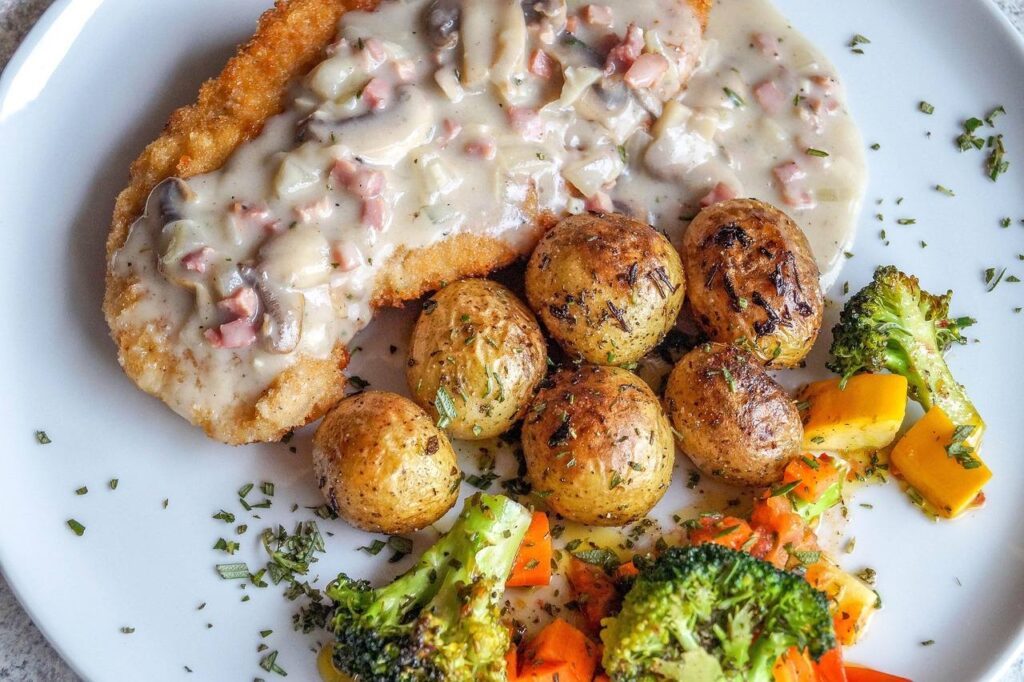
Wiener Schnitzel is a veal cutlet breaded in flour, egg and breadcrumbs and fried plain, no sauce, by definition in Austria’s own food code. Jägerschnitzel is a different animal entirely, sometimes literally: traditionally a thin venison or wild boar cutlet, unbreaded, pan-fried and served under a mushroom “hunter’s” gravy, though most restaurants today serve a breaded pork version with the same sauce spooned over it. The sauce’s name and mushroom base are often traced to the French sauce chasseur, “hunter’s sauce”. The two dishes share a shape and a country of origin, Austria, and not much else: one is defined by its breading, the other by its sauce.
Disclosure: some links on this page are affiliate links, marked by the products, tours and hotels they name. As an Amazon Associate, bavarianbistro.com earns from qualifying purchases. A purchase through these links may earn the site a commission at no cost to you, and it never affects what is recommended. How this works.
Order both at the same table and you can tell them apart before either plate lands, just from what the kitchen has to do to make them. One gets breaded and fried dry, sauce nowhere in sight. The other gets smothered, crust or no crust, in gravy the color of a Tuesday in November. That single difference is really two dishes wearing near-identical names, and it untangles fast once you know which rule governs which. Both belong in my guide to Bavarian food, even though, like a fair number of dishes on a Bavarian menu, neither one started in Bavaria. The names even mean different things: one tips its hat to a city, the other to a job.
The short answer
Here is what separates them, side by side.
| Wiener Schnitzel | Jägerschnitzel | |
|---|---|---|
| Meat, by tradition | Veal | Venison or wild boar |
| Meat, most common today | Veal (by definition; another animal needs its own name) | Pork |
| Breaded? | Yes, always | Traditionally no; commonly yes today |
| Sauce | None | Mushroom “hunter’s” gravy |
| Name means | “Viennese” | “Hunter’s” |
| Country of origin | Austria | Austria, now widespread in German cuisine |
Why Wiener Schnitzel never has a sauce
Austria’s own food code defines Wiener Schnitzel narrowly: a veal cutlet, coated in flour, beaten egg and breadcrumbs, then fried in fat, and nothing in that definition leaves room for gravy12. A sauced schnitzel is, by the same logic that keeps a pork cutlet from being called “Wiener Schnitzel,” a different dish with a different name, whatever a menu’s translation into English wants to imply. If a menu lists Wiener Schnitzel “mit Sauce,” it is either translating loosely or serving the sauce on the side rather than over the cutlet, and I would ask the server which before I decided how to feel about it. My Wiener Schnitzel FAQ covers the naming rule in full.
Why Jägerschnitzel is a sauce first and a cutlet second
Jägerschnitzel takes its name from the German word for hunter, and the earliest versions were built around what a hunter would actually have on hand: venison or wild boar loin, pounded thin, pan-fried plain, and finished with a gravy built from mushrooms, the point of the dish, which some food historians trace to the French sauce chasseur, itself named for the hunt3. That history is also why the traditional version skips the breading Wiener Schnitzel is built around: a delicate wild-game cutlet does not need a crust to hold its own against a sauce.
Most restaurants now make Jägerschnitzel with a breaded pork cutlet, since pork is cheaper and easier to source than venison, the same mushroom gravy ladled over the crust rather than around a bare cutlet; one German recipe site sums up the modern version bluntly as “Crispy breaded pork cutlets served with rich mushroom gravy,” and some regions still serve it the older way, unbreaded, closer to a plain pan-fried cutlet in gravy3. Neither version is wrong. They are two points on the same dish’s history, and a menu rarely tells you which one you are getting until it lands on the table, breading and all, with the gravy already poured.
Resi says If breading matters to you, ask before you order. “Jägerschnitzel” alone will not tell you whether there is a crust hiding under that gravy or nothing but a bare cutlet; both versions are common enough that no kitchen will blink at the question, and I would rather sound fussy for ten seconds than eat a surprise.
Cooking both at home
Both dishes start the same way: a cutlet pounded thin and even, which a flat meat mallet does more evenly than the back of a pan, and the same mallet handles veal for a Wiener Schnitzel or pork for a Jägerschnitzel equally well4. Pound it too thin and it tears before it ever sees the pan; leave it too thick and the breading burns before the middle catches up. Even, not thin for its own sake, is the goal for both.
Resi says Buy the mallet. A rolling pin is a baking tool wearing a costume, and it tears the meat about as often as it flattens it. One mallet handles both cutlets in this article, veal or pork, and asks nothing else of you.
From there the paths split. Wiener Schnitzel gets floured, egged, breaded and fried, then served as it comes out of the pan, usually with nothing more than a lemon wedge, and I would leave it there; a sauce on Wiener Schnitzel is a different dish wearing the wrong name. Jägerschnitzel, in its breaded form, follows the same steps up to the pan, then gets a ladle of mushroom gravy over the top; in its unbreaded form, the cutlet is simply salted, floured lightly if at all, pan-fried, and set aside while the same pan builds the gravy. My Jäger sauce guide walks through building that gravy from what is left in the pan, fond and all.
Frequently Asked Questions
Is Jägerschnitzel breaded?
It depends on the region and the kitchen. The traditional version is an unbreaded, pan-fried cutlet in mushroom gravy, but most restaurants today serve a breaded version, closer to a Wiener Schnitzel with gravy on top.
Is Jägerschnitzel made with pork or venison?
Traditionally venison or wild boar. Most restaurants now use pork, which is cheaper and more widely available.
Where does the name "Jägerschnitzel" come from?
“Jäger” is German for hunter, a reference to the dish’s origin as a wild-game cutlet with a mushroom sauce built the way a hunter might improvise one.
Is Jäger sauce related to French sauce chasseur?
The mushroom-based gravy is often traced to sauce chasseur, French for “hunter’s sauce,” though the German version has developed along its own lines.
Does Wiener Schnitzel ever come with a sauce?
Not by Austria’s own definition of the dish, which specifies a plain, breaded, pan-fried veal cutlet with no sauce.
Is Jägerschnitzel a Bavarian dish?
It is originally Austrian, like Wiener Schnitzel, and is now common across German cuisine generally, including in Bavaria, without being a Bavarian invention.
Can I order Jägerschnitzel unbreaded?
In some regions that is the traditional version, and a restaurant that specializes in older-style Bavarian or Austrian cooking may serve it that way by default. Ask if you are not sure which version is on the menu.
Related Articles
 Bavarian Food: The Dishes, How Munich Eats Them, and What to Cook at HomeFood
 Wiener Schnitzel FAQ: Veal or Pork, Austrian or German, and Why It Is Not a Hot DogFood
 Jäger Sauce: The Hunter’s Mushroom Gravy for JägerschnitzelFood
 Browning Meat: The Flavor-Building Step Behind Goulash, Stews and RoastsFood
 Rouladen: The Rolled Beef Dish on Every Bavarian Menu That Is Not BavarianFood
 Sauerbraten: The Marinated Pot Roast, Where It Comes From and How Bavaria Serves ItFood
 How to Read a Bavarian Menu: 60 Words from Brezn to ZwetschgendatschiFood
Sources
- A.4.1.3 Bezeichnung — Österreichisches Lebensmittelbuch (Austrian Food Codex). Accessed 2026-09-24.
- A.4.1.1 Beschaffenheit — Österreichisches Lebensmittelbuch (Austrian Food Codex). Accessed 2026-09-24.
- Authentic German Jagerschnitzel (Hunter Schnitzel with Mushroom Gravy) — The Daring Gourmet. Accessed 2026-09-24.
- Meat Tenderizer, 304 Stainless Steel Heavy Sturdy Meat Mallet/Pounder/Hammer Tool (1.65lb) — Amazon.com. Accessed 2026-09-24.