In brief
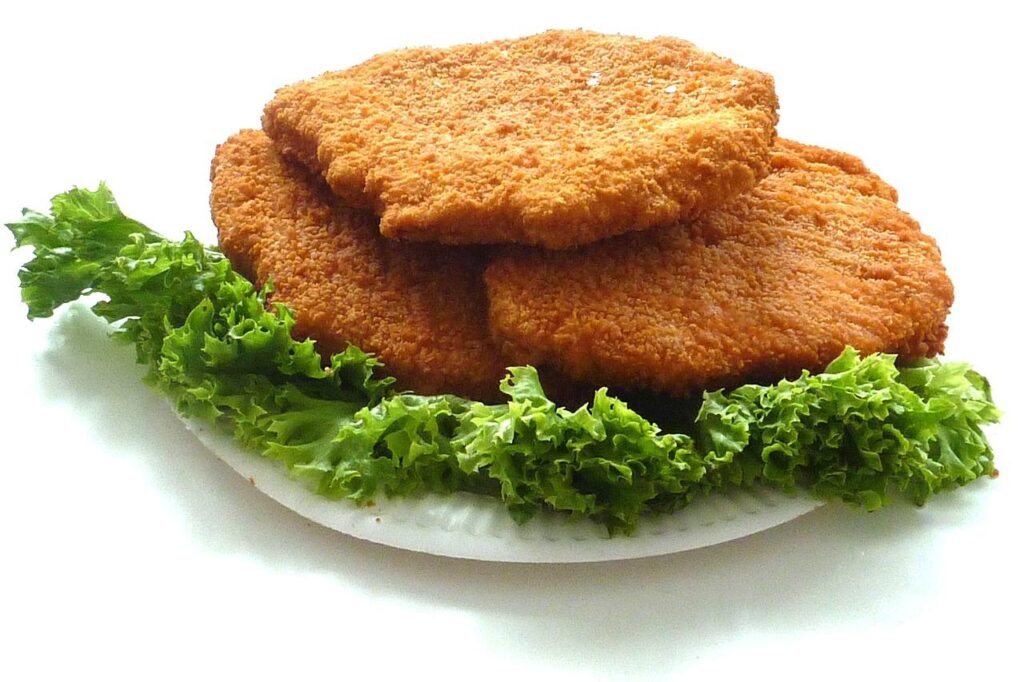
Wiener Schnitzel is a veal cutlet in flour, beaten egg and breadcrumbs, fried in fat, and Austria’s own food code is the one that says so, narrowly. That is not opinion: bread a pork cutlet the same way and the code requires a different name, Schweinsschnitzel, not Wiener Schnitzel. Which makes the dish Austrian, not German or Bavarian, however often it turns up on a Munich menu. It has nothing to do with the hot dog chain of nearly the same name, founded in Southern California in 1961, a century after Vienna’s cutlet already had its name. And it is not Jägerschnitzel, which trades the crust for a mushroom gravy.
Disclosure: some links on this page are affiliate links, marked by the products, tours and hotels they name. As an Amazon Associate, bavarianbistro.com earns from qualifying purchases. A purchase through these links may earn the site a commission at no cost to you, and it never affects what is recommended. How this works.
You are staring at a menu that lists “Wiener Schnitzel” on one line and “Schnitzel Wiener Art” a few lines down, and you have decided the kitchen typoed the same dish twice. It did not. The two cutlets can look identical under the breadcrumbs, right down to the parsley garnish, and the whole difference rides on one ingredient that Austria’s food authorities cared enough about to put into law rather than leave to a menu writer’s judgment. This page settles what the dish actually has to contain, whether it is Austrian or German, how it relates to the sauced cutlet called Jägerschnitzel, and why an American drive-through chain with almost the same name sells hot dogs instead of veal. It belongs in my guide to Bavarian food for the same reason a few other dishes on that list do: everyone assumes it is Bavarian, and not one of them asked Austria first.
What the name actually requires
The Österreichisches Lebensmittelbuch, Austria’s official food code, does not just describe Wiener Schnitzel. It defines it. On its own, “Schnitzel” is treated as any trimmed piece of meat prepared for a dish sold under that word, while the specific dish names carry their own rules, and “Wiener Schnitzel” is reserved for one thing: a cutlet of veal, coated in flour, beaten egg and breadcrumbs, then fried out in fat. Whatever animal the meat actually comes from has to be named alongside the word “Schnitzel” for anything that is not veal, so a beef version is a Rindsschnitzel and a pork one is a Schweinsschnitzel1.
The same section of the code is just as narrow about Cordon bleu: the name is only allowed for a breaded veal cutlet, either two thin cutlets sandwiched together or one cut open like a pocket, filled with ham and cheese1. A chicken version, however common on an English-language menu, is not a Cordon bleu by Austria’s own definition, and I would not order one expecting otherwise.
Resi says If a menu lists plain “Schnitzel” with nothing else attached, ask what it is made from before you order. Austria’s code treats “Schnitzel” as a cut of meat with no promises attached, and the kitchen is under no obligation to volunteer which animal donated it.
Veal, not pork
Veal, by the only official definition either country has put in writing. A cutlet made from pork, chicken or turkey and breaded the same way is a real dish, often a good one, but Austria’s food code will not let it borrow the name “Wiener Schnitzel”1. A restaurant serving the pork version is, by that same code’s logic, supposed to name the pig, not the city.
Germany has no equivalent law of its own, which is part of why the name gets used loosely once you cross the border. What does not change, border or no border, is which country wrote the definition, and that country’s law says veal.
Austrian, not German or Bavarian
Austrian. The Österreichisches Lebensmittelbuch is Austria’s code, not Germany’s and not Bavaria’s, and it is Austria’s own food authorities who maintain the chapter that defines the dish12. Bavaria sits an hour from the Austrian border, shares a language with it, and has absorbed plenty of its cooking, which is exactly why Wiener Schnitzel shows up on so many Bavarian menus without being a Bavarian dish, the same way Kaiserschmarrn and Apfelstrudel do.
None of that makes it any less ordered in Munich. It is one of the most popular dishes in the city. It is just not one of the city’s own, and I have made my peace with that the way most Bavarians have.
Not Jägerschnitzel, either
It is also not the sauced cutlet called Jägerschnitzel, which was traditionally venison or wild boar rather than veal, and which trades the breadcrumbs for a mushroom “hunter’s” gravy instead of frying plain4. The two get confused by English speakers more than by anyone actually ordering in German, mostly because both arrive as a cutlet on a plate.
Not the hot dog chain
If you have searched “Wienerschnitzel” in the United States, you may have found a very different business: a fast-food chain that sells hot dogs, not cutlets. It was founded in 1961 by John Galardi, who opened the first stand in Southern California, and the company’s own history page describes it growing from that single location into what it calls the world’s largest hot dog chain3. The name borrows the word, not the dish, and the two have no connection beyond it. If a friend recommends “Wienerschnitzel” and means a drive-through, you are not about to eat veal.
Making it at home
A veal cutlet has to be pounded thin and even before it will fry properly, thin enough that it puffs and cooks through in the couple of minutes the breading takes to turn golden. Many butchers will pound cutlets for you if you ask.
If you are doing it yourself, a flat-sided meat mallet works better than the back of a pan, which tends to tear the meat instead of flattening it, and a basic stainless-steel one handles veal, chicken, or the boar-sized cutlet if you make Jägerschnitzel from scratch5.
Resi says Buy the mallet. A rolling pin turns a cutlet into lace, and the bottom of a pan turns it into a personal grudge you will lose. Spend the ten dollars and save the good pan for something that deserves it.
Dredge the pounded cutlet in flour, then beaten egg, then fresh breadcrumbs, pressing gently so the crumbs stick without compacting into a crust. Fry it in a shallow pool of clarified butter or neutral oil, hot enough to bubble around the edges immediately, and let the schnitzel move slightly in the pan as it cooks so the breading puffs rather than fuses flat. Two to three minutes a side is usually enough for a cutlet pounded to about a quarter-inch.
Frequently Asked Questions
Is Wiener Schnitzel made from pork or veal?
Veal, by Austria’s own food code, which defines “Wiener Schnitzel” as a breaded, pan-fried veal cutlet. A pork version made the same way has to be named for the pig, not sold as Wiener Schnitzel.
Is Wiener Schnitzel Austrian or German?
Austrian. The dish is defined in the Österreichisches Lebensmittelbuch, Austria’s official food code, not a German one.
Is the fast-food chain Wienerschnitzel related to the Austrian dish?
No. The chain, founded in 1961 by John Galardi in Southern California, sells hot dogs, not schnitzel, and has no connection to the Austrian dish beyond sharing part of its name.
Is Cordon bleu a kind of Wiener Schnitzel?
It is a related but separate dish. Austria’s food code reserves the name “Cordon bleu” for a breaded veal cutlet filled with ham and cheese, either two cutlets sandwiched together or one cut open like a pocket.
What is the difference between Wiener Schnitzel and Jägerschnitzel?
Wiener Schnitzel is breaded and served plain. Jägerschnitzel is traditionally venison or wild boar in a mushroom “hunter’s” gravy, and in many restaurants today is a breaded pork cutlet with the same sauce spooned over it. My comparison of the two covers the rest.
Do you need veal to make a good schnitzel at home?
Veal is what the name requires, but a pork or chicken cutlet pounded and breaded the same way makes a good meal. Just do not call it Wiener Schnitzel if you want to be accurate about it.
Why does the naming rule exist at all?
Austria’s food code treats “Schnitzel” as a generic cut of meat and reserves specific dish names, such as “Wiener Schnitzel” and “Cordon bleu,” for particular combinations of animal and preparation, so that ordering one tells you what you are getting before it arrives.
Related Articles
 Bavarian Food: The Dishes, How Munich Eats Them, and What to Cook at HomeFood
 Wiener Schnitzel vs Jägerschnitzel: Breaded or SaucedFood
 Jäger Sauce: The Hunter’s Mushroom Gravy for JägerschnitzelFood
 Bavarian vs German Food: What Is Actually DifferentFood
 Rouladen: The Rolled Beef Dish on Every Bavarian Menu That Is Not BavarianFood
 Sauerbraten: The Marinated Pot Roast, Where It Comes From and How Bavaria Serves ItFood
 How to Read a Bavarian Menu: 60 Words from Brezn to ZwetschgendatschiFood
Sources
- A.4.1.3 Bezeichnung — Österreichisches Lebensmittelbuch (Austrian Food Codex). Accessed 2026-09-24.
- A.4.1.1 Beschaffenheit — Österreichisches Lebensmittelbuch (Austrian Food Codex). Accessed 2026-09-24.
- About Wienerschnitzel — Wienerschnitzel. Accessed 2026-09-24.
- Authentic German Jagerschnitzel (Hunter Schnitzel with Mushroom Gravy) — The Daring Gourmet. Accessed 2026-09-24.
- Meat Tenderizer, 304 Stainless Steel Heavy Sturdy Meat Mallet/Pounder/Hammer Tool (1.65lb) — Amazon.com. Accessed 2026-09-24.