In brief
Bamberg’s entire old town is a UNESCO World Heritage Site, built across three hills and an island in the Regnitz, and its own tourism board calls the hill city “the Franconian Rome”. The postcard corner is Little Venice, a row of half-timbered former fishermen’s houses on the riverbank on the island side of town. Beer is not a side note here; the city’s own description calls it “a traditional craft, supped in traditional brewery pubs,” and Bamberg is the historic home of Rauchbier, smoked beer, most famously from the Schlenkerla brewery. It reaches easily from either Munich or Nuremberg on the Bayern-Ticket, Deutsche Bahn’s regional day pass, which starts at €34 for one traveler.
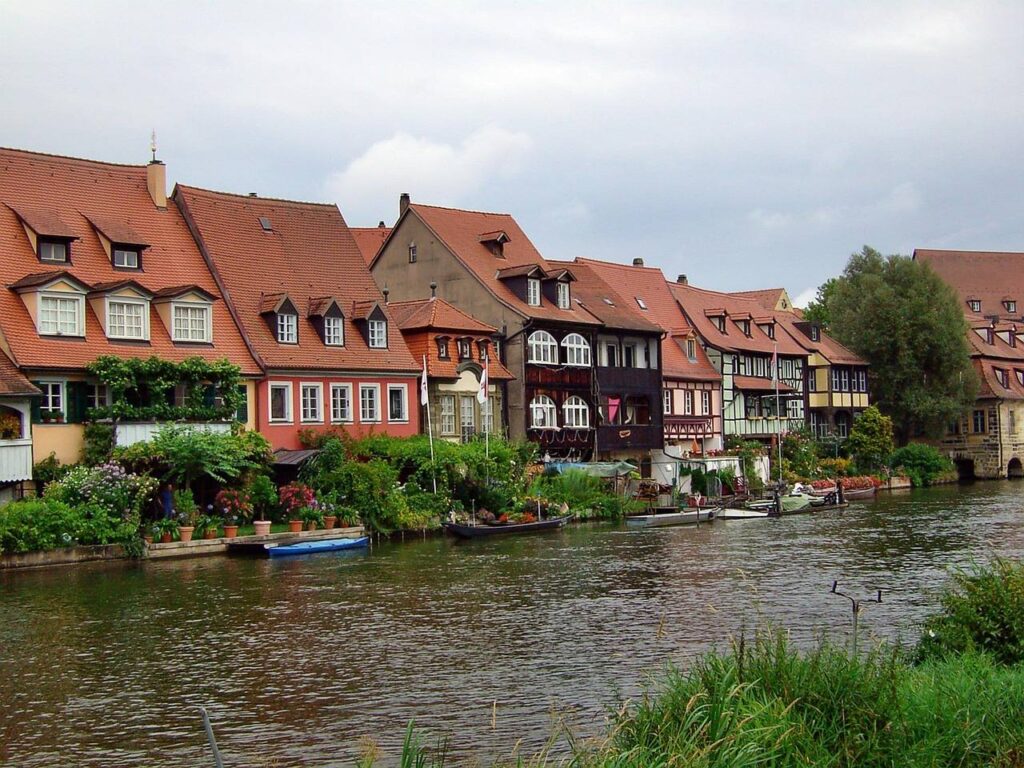
Bamberg is the stop on a Bavaria by train week that people mean to add and then run out of days for, usually because Nuremberg and Munich eat the whole itinerary first. That is a mistake proportional to how good this city actually is: an entire UNESCO-listed old town, built on hills and water, that somehow never turned itself into a museum piece. People still live here, brew here and drink here, and a single day is enough to see why locals think that is the whole point.
A city on three hills and a river island
Bamberg’s tourism board describes its own old town in three parts: the hill city, which it calls the Franconian Rome for its cluster of churches on high ground; the island city, sitting between two arms of the Regnitz and including Little Venice; and the Gärtnerstadt, the market gardeners’ district that once fed the whole town1. The whole is UNESCO World Heritage, and it earns the designation the ordinary way, by having survived largely intact rather than by being rebuilt to look old.
Little Venice, Klein Venedig in German, is the part every photograph of Bamberg is actually a photograph of: a run of small, half-timbered former fishermen’s cottages along the Regnitz, each with its own little dock, on the island side of the old town1. It costs nothing to walk it and rewards an unhurried pace more than almost anywhere else on this list. Above the old town, the hilltop castle of Altenburg is listed among the city’s recommended sights, and it is the view most people climb for, though I could not confirm current hours or an admission price on the city’s own site as of this writing, so check on arrival rather than plan around a schedule I have not seen myself1.
Resi says Bamberg rewards the person who puts nothing else on the schedule. Little Venice does not take an hour; it takes as long as you are willing to stand on a bridge doing nothing, and that is not a complaint.
The beer the city is actually known for
Beer culture is not tourism-board flattery in Bamberg; the city’s own copy calls it a traditional craft, “supped in traditional brewery pubs,” and that is close to literal fact for a town with this many working breweries in walking distance of each other1. Bamberg is the historic home of Rauchbier, beer brewed with malt dried over an open flame, which gives it a smoked, almost bacon-like character that either wins you over in one glass or does not, and the best-known producer is the Schlenkerla brewery. I cannot confirm Schlenkerla’s specific brewing history or hours from an official page I have seen myself, so I am not going to hand you numbers I do not have; if the topic pulls you in, my dedicated Bamberg’s Rauchbier page is the one to read before you go, and my Bavarian Beer, Explained pillar covers where smoked beer sits next to Helles and Weißbier.
Getting there, from either direction
Bamberg’s trick is that it is a genuine day trip from two different cities, not just one. From Munich or from Nuremberg, the Bayern-Ticket is the natural way in: Deutsche Bahn’s regional day pass starts at €34 for one traveler in second class and scales to €74 for a group of five, covers “all regional trains, transport associations, and nearly all bus lines in Bavaria,” and excludes only the fast ICE and IC lines. On weekdays it is valid from 9 a.m. to 3 a.m. the next day; on weekends and holidays, from midnight. Up to three children aged six to under fifteen ride free with an adult, and younger children always do2. Because Nuremberg sits closer to Bamberg than Munich does, pairing the two into one day, Nuremberg in the morning and Bamberg in the afternoon, is a realistic plan if your base is Munich and you are willing to make a long day of it; my Nuremberg page covers the first half.
Resi says If you only have one day and you are staying in Munich, do not try to add a third city to Nuremberg and Bamberg in the same trip. Two cities and an unhurried Little Venice beats three cities and a train platform at dusk.
What a day actually looks like
Walk the old town’s three quarters first, while you have the patience for hills; the hill city’s churches are the part that takes real legwork. Come down into the island city for Little Venice and lunch, and spend whatever is left of the afternoon in a brewery pub, which is a perfectly respectable way to end a day built around a UNESCO site. Nuremberg’s Kaiserburg and Neuschwanstein both demand a timed entry slot booked around a fixed schedule; Bamberg has no equivalent single ticketed site, and that changes the whole shape of the day. Nobody is checking a clock here, and the town rewards the person who lets the walk decide the order rather than a printed itinerary.
That lack of a headline ticket is also the reason Bamberg gets skipped by people building a first Bavaria trip around castles and beer halls: there is no single photo-op attraction to anchor a search, only a town that is better than the sum of its individually modest sights. The Gärtnerstadt, the old market-gardening district that once supplied the town’s vegetables, is the part almost nobody outside Bamberg has heard of, and it is worth the detour precisely because it is not on anyone’s list of the three big things to see. Bring comfortable shoes for the hill city’s cobbles, and do not schedule a train home before you are ready to leave; a day here compresses badly.
Frequently Asked Questions
Is Bamberg worth a day trip from Munich?
Yes, though it is a longer day than Nuremberg or Regensburg since Bamberg sits farther north; pairing it with Nuremberg on the same day works if you start early.
Is Bamberg closer to Nuremberg or Munich?
Nuremberg. Bamberg sits north of Nuremberg, which makes the two an easy pairing for one long day out of Munich.
What is Little Venice in Bamberg?
Klein Venedig, a row of small half-timbered former fishermen’s houses along the Regnitz on the island side of Bamberg’s old town, each with its own tiny dock.
What is Rauchbier?
Bamberg’s smoked beer, brewed with malt dried over an open flame, giving it a distinctive smoky character; the best-known producer is the Schlenkerla brewery.
Is Bamberg's old town really a UNESCO World Heritage Site?
Yes, the entire old town, spanning the hill city, the island city and the Gärtnerstadt gardening district.
How do you get to Bamberg without a car?
By regional train, covered by the Bayern-Ticket from either Munich or Nuremberg.
Do you need tickets booked in advance for Bamberg?
No single attraction in Bamberg requires the kind of timed-entry booking that Neuschwanstein or the Nuremberg Documentation Center does; it is a walking city.
Related Articles
 Bavaria by Train: Day Trips from Munich and a Week Without a CarBavaria
 Nuremberg Beyond the Christmas MarketBavaria
 Regensburg Day Trip from MunichBavaria
 Würzburg: The Residenz and Franconia’s WineBavaria
 The Bayern-Ticket: One Day of Regional Trains for a Group, ExplainedBavaria
 Bavarian Beer, ExplainedBeer
 One Week in Bavaria by TrainBavaria
Sources
- Bamberg — en.bamberg.info, City of Bamberg. Accessed 2026-09-27.
- Bayern-Ticket — bahn.de, Deutsche Bahn. Accessed 2026-09-27.