In brief
Seven days by train covers Munich, Neuschwanstein, the Zugspitze and either Berchtesgaden or the Franconia cities, without a rental car and without repeating a train route. The Bayern-Ticket, Bavaria’s regional day pass, covers most of these legs for a group, from €34 for a solo traveler up to €74 for five people. The version below moves your base three times: two nights in Munich, a night near Füssen for Neuschwanstein, a night in Garmisch-Partenkirchen for the Zugspitze, and back to Munich for the last two days. It skips the rental car entirely; my guide to renting a car in Bavaria is there if you’d rather drive one of these legs instead.
Seven days is the number that turns a highlight reel into an actual trip, as I get into on my how many days in Bavaria page. This is one workable shape for that week, built entirely around trains and the Bayern-Ticket, with three changes of base so you’re not doing every leg as an exhausting same-day round trip from Munich. Swap days around freely; the logic underneath — cluster the Alps together, keep Franconia separate — is the part worth keeping.
The week, day by day
| Day | Base | What it covers |
|---|---|---|
| 1–2 | Munich | Arrival, the old town, a beer garden |
| 3 | Füssen | Neuschwanstein and Hohenschwangau |
| 4–5 | Garmisch-Partenkirchen | Linderhof, Oberammergau, the Zugspitze |
| 6 | Munich | Berchtesgaden and the Königssee |
| 7 | Munich | Nuremberg, Regensburg or Bamberg, then depart |
Days 1–2: Munich
Land, settle in, and give yourself the first evening to do nothing ambitious; my arriving in Munich page has the airport-to-city logistics, and Munich’s public transport is worth understanding before you need it for a 7 a.m. train. Day two is Munich itself: the old town, the Viktualienmarkt, and a beer garden if the weather holds, all covered in my first-trip guide to Munich and Bavarian beer guide.
Day 3: Neuschwanstein, and a night in Füssen
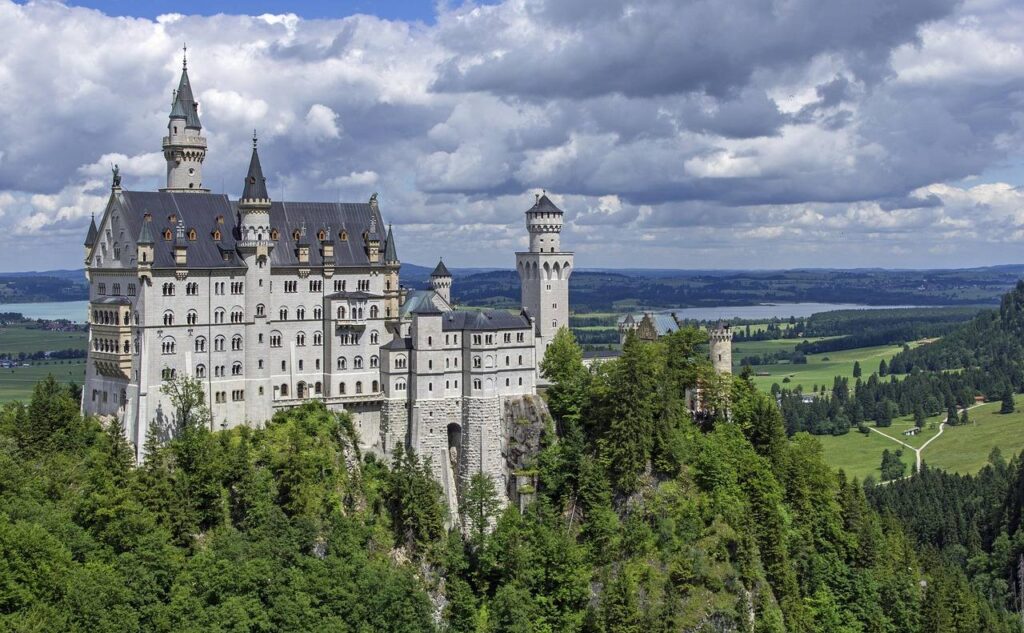
This is the day worth not rushing. Neuschwanstein and Hohenschwangau Castles are only toured on a fixed-time guided visit, and the castle administration recommends arriving in Hohenschwangau one and a half to two hours before your slot2. Book the Neuschwanstein tickets ahead, and consider doing this leg as an overnight rather than a same-day round trip from Munich: staying in Füssen’s own town center, near the train station, means you’re not racing a train timetable on top of a timed castle entry. My Neuschwanstein by train page has the full route, and King Ludwig’s castles covers Neuschwanstein’s place among the four sites in Bavaria’s 2025 UNESCO inscription3.
Days 4–5: Linderhof, Oberammergau and the Zugspitze
From Füssen, move on toward Garmisch-Partenkirchen, with Linderhof Palace and the woodcarving village of Oberammergau on the way. Base in Garmisch-Partenkirchen itself for two nights, in the town center near the station rather than out toward the ski areas, since the next morning’s plan is the Zugspitze, Germany’s highest peak, reached by cogwheel train or cable car. A round-trip Zugspitze ticket runs €78 for an adult, or €46 one-way4. If you have the extra half-day, Mittenwald is a short hop further into the Karwendel range and worth it for the painted house facades alone.
Day 6: Berchtesgaden and the Königssee
Back to Munich as your base, and out again the same day to Berchtesgaden: the Königssee boat trip, with its trumpet-echo party piece, runs about 35 minutes to St. Bartholomä and about an hour to Salet5. If the Eagle’s Nest is part of the plan, check the season first — the Kehlstein road only runs roughly early May to mid-October, weather permitting, and is unusable in snow and ice6.
Day 7: Franconia, or Salzburg, then depart
Your last full day is where the week can flex most. Nuremberg, Regensburg and Bamberg are all reachable on the Bayern-Ticket, and any one of them makes a good last day before an evening or next-morning departure. If a second country appeals more than a third German city, Salzburg is under two hours away and covered by the same ticket.
Resi says Don’t try to fit Berchtesgaden and a Franconia city into the same week if you’re also doing Neuschwanstein and the Zugspitze. That’s five day trips stacked around three changes of base, and the week stops being a vacation somewhere around day five. Cut one before you leave, not while you’re standing in a station deciding.
Where to base yourself, night by night
Munich for nights one, two, six and seven: stay anywhere with easy access to the Hauptbahnhof, since nearly every day trip in this itinerary starts from there. For the Neuschwanstein night, Füssen’s own train station puts you close to the regional bus into Hohenschwangau village the next morning, rather than adding that leg onto an already long castle day. For the Zugspitze nights, Garmisch-Partenkirchen’s town center keeps you close to the station serving both the cogwheel railway and the trains back toward Munich or on to Mittenwald.
Moving bases without a car
Changing your base three times sounds like more logistics than it is. Bavaria’s regional trains handle luggage without any special arrangement, and none of the three moves in this itinerary — Munich to Füssen, Füssen onward toward Garmisch-Partenkirchen, Garmisch-Partenkirchen back to Munich — involves more than one change. Pack for that: one bag each you can carry up a flight of station stairs, not a suitcase you’re wrestling onto a regional train with a five-minute connection. If the week runs during ski season or deep summer, book the Füssen and Garmisch-Partenkirchen nights before the Munich ones; those two towns are small enough that availability tightens faster than Munich’s does.
Frequently Asked Questions
Can you see Bavaria in a week without a car?
Yes. This itinerary covers Munich, Neuschwanstein, the Zugspitze and either Berchtesgaden or a Franconia city entirely by train, using the Bayern-Ticket for most of the regional legs.
Is one week enough for Neuschwanstein and the Zugspitze both?
Yes, if you move your base rather than day-tripping both from Munich. Staying a night near Füssen and a night or two in Garmisch-Partenkirchen removes the longest, most tiring travel days.
Do you need to book Neuschwanstein tickets before the trip?
Yes. Entry is timed and can sell out, so book ahead rather than planning to buy on arrival.
Is the Bayern-Ticket enough for a whole week in Bavaria?
For most of the days above, yes, since it’s a group day pass covering regional trains, S-Bahn, trams and buses across Bavaria. It doesn’t cover ICE or IC trains.
Should the week include Salzburg?
Only if you’d rather trade one Franconia city for a second country. Salzburg is under two hours from Munich and covered by the Bayern-Ticket.
What's the biggest mistake in a one-week Bavaria itinerary?
Scheduling a day trip on every single day. Build in at least one slower day, especially around the Alpine legs, which run long once you count the train and the timed entries.
Related Articles
 Bavaria by Train: Day Trips from Munich and a Week Without a CarBavaria
 How Many Days Do You Need in Bavaria?Bavaria
 The Bayern-Ticket: One Day of Regional Trains for a Group, ExplainedBavaria
 Neuschwanstein Tickets: How the Timed Entry WorksBavaria
 Is Salzburg Worth a Day Trip from Munich?Bavaria
 Renting a Car in Bavaria: When It Beats the TrainBavaria
 Munich for a First Trip: What Is Worth It, What Is Not, and How the City WorksMunich
 Arriving in Munich: Airport to CityMunich
Sources
- Regional day ticket Bavaria (Bayern-Ticket) — Deutsche Bahn. Accessed 2026-09-27.
- Official tickets for Neuschwanstein and Hohenschwangau — Hohenschwangau/Neuschwanstein official visitor information. Accessed 2026-09-24.
- Inscription of the castles of King Ludwig II of Bavaria to the UNESCO World Heritage list — German Federal Foreign Office. Accessed 2026-09-24.
- Zugspitze tickets and rates — Bayerische Zugspitzbahn. Accessed 2026-09-24.
- Königssee — Bayerische Seenschifffahrt. Accessed 2026-09-24.
- Das Kehlsteinhaus / Eagle’s Nest — Berchtesgaden tourism. Accessed 2026-09-24.