In brief
A Bavarian pantry needs one flour close to US all-purpose, dry bread crumbs for schnitzel and dumplings, a jar of sauerkraut, sweet mustard, and a spice drawer with caraway and marjoram already in it. German flour is numbered by mineral content rather than by use, but both fetched guides agree that Type 405 tracks closest to US pastry flour and Type 550 to all-purpose. None of it requires a special trip if you know what to substitute, and only a few items are worth ordering from a specialty importer at all.
Disclosure: some links on this page are affiliate links, marked by the products, tours and hotels they name. As an Amazon Associate, bavarianbistro.com earns from qualifying purchases. A purchase through these links may earn the site a commission at no cost to you, and it never affects what is recommended. How this works. Product prices and availability shown are as of the date stated and can change; the Amazon price at checkout applies.
You do not need a German grocery store to cook Bavarian food regularly; you need about eight items, most of which are already at your regular supermarket under a different name, and one or two that are worth a specialty order if you bake often. This page is the shopping list behind my guide to cooking Bavarian in North America, sorted by what each staple is actually for, not by aisle, so you can shop for a dish rather than a category.
Flour: the numbers are not a use case
German flour is sold by type number, based on mineral, or ash, content, while the US sorts flour by intended use, all-purpose, cake, bread, pastry. Germanfoods.org’s own flour guide maps Type 405 to “cakes, cookies, pastries, pancakes, waffles, lighter baked goods,” Type 550 to “yeast dough, Brötchen, white bread, pizza dough, pretzels, everyday baking,” and Spelt Type 630 to “cakes, pastries, rolls, Spätzle, lighter spelt baking”1.
A second source, Elle Republic, translates the same types into US terms more directly: Type 405 to US pastry flour, Type 550 to US all-purpose (“a decent choice for almost everything”), and cautions that European and North American flours are not directly comparable because of different wheat varieties2. The two sources disagree on where Type 812 and Type 1050 land against US bread and high-gluten flour, so treat the 405-to-pastry and 550-to-all-purpose equivalence as solid and everything past that as a rough guide, not a substitution rule12. For pretzels, reach for Type 550 or plain all-purpose; for Spätzle, spelt flour or a soft pastry flour gets closer than bread flour will.
If you do want the real German-numbered flour rather than a US substitute, One Stop German Shop carries a flour collection of 24 SKUs, priced $4.99 to $10.99, from millers including Küchenmeister, Brot & Crust, Mühlenkönig, Kathi and Seitenbacher, shipped from a New Jersey warehouse in three to five days3. That is a real option if you bake often enough to notice the difference between 550 and all-purpose; for the occasional pretzel or batch of Spätzle, the substitutes above are close enough not to bother with shipping.
Bread crumbs and dumpling mixes
Semmelbrösel, dry bread crumbs made from white bread, do the same two jobs in a Bavarian kitchen that they do in any kitchen: breading and binding. Leimer’s own version, sold as a 400-gram box for $4.10, lists wheat flour, yeast and salt as its ingredients and is marketed by the retailer as good for breading schnitzel, forming dumplings, or topping vegetables4. Keep a box on hand for Wiener Schnitzel, where a fine, dry crumb is the difference between a crisp coating and a soggy one, and for the bread dumplings in my Knödel guide, where stale bread cubes are the traditional base and a bag of dry crumbs is the shortcut when you did not plan ahead.
Instant dumpling mixes are the shortcut worth knowing about, not necessarily the one worth relying on. Pfanni’s Potato Dumpling Mix, which makes about 12 Knödel, sells through a US specialty importer for $6.29, though it showed as out of stock when I checked5. A Semmelknödel, or bread dumpling, version of the same brand turns up in search results at other retailers, but I could not confirm a price on an actual product page this session, so I am not quoting one; check current stock and read the label yourself before you plan a dinner party around a box that might not be sitting on the shelf.
Sauerkraut: imported jar or Aldi shelf
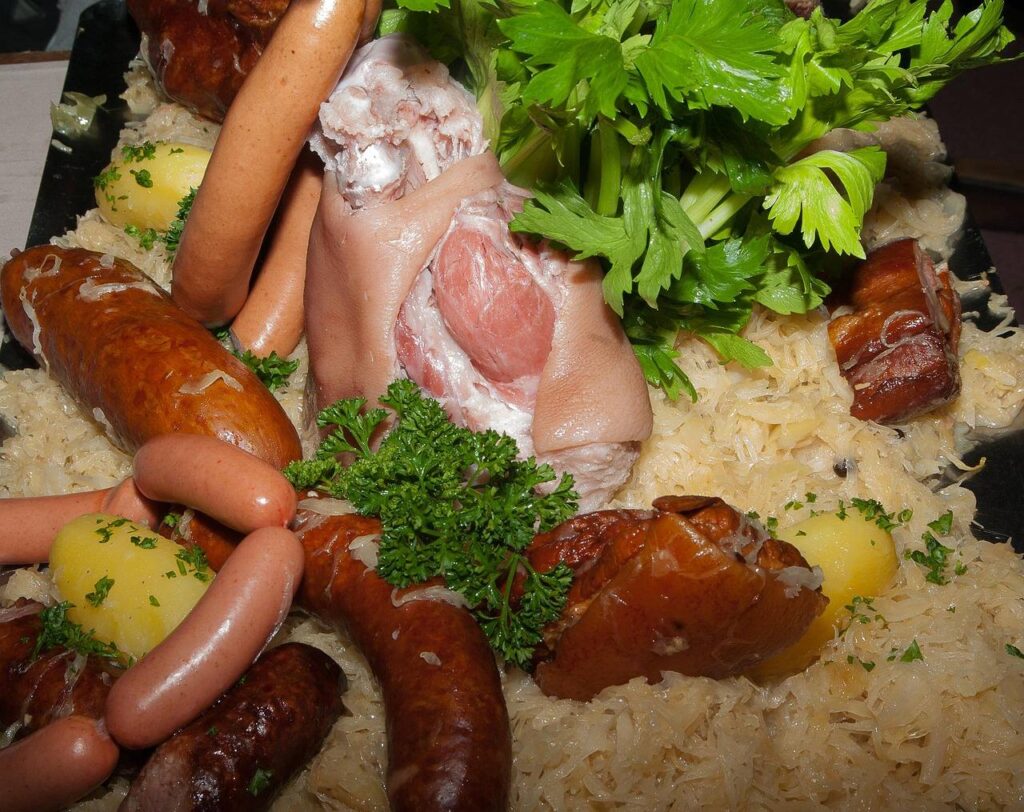
Sauerkraut sits under almost every Schweinshaxe and Schweinebraten in Bavaria, and North America has two very different price points for it. Hengstenberg’s Bavarian Wine Sauerkraut runs 24 ounces for $5.45 through The Taste of Germany, the imported option with the brand recognition; Aldi’s own Deutsche Küche German Style Sauerkraut, also 24 ounces, rang up at $1.55 on Aldi’s US site, a fraction of the price for what is, at the level a home cook needs, the same job done67.
Resi says Ever since Aldi showed up in our state, the drought was over. Their Deutsche Küche line is absolutely the real deal, and my favorites are the frozen strudels, the bratwursts, the sweet mustard and the black sunflower seed bread. It only shows up once or twice a year, so when you see it, stock up.
The mustard aisle
Bavarian sweet mustard, coarse, brown and sweetened, is a different animal from sharp yellow senf, and the brand map is bigger than one jar. Develey’s own product page names its Original Münchner Weißwurstsenf as the direct equivalent of what Bavarians call Bayerischer Süßer Senf, Bavarian sweet mustard, and sits on shelves next to Löwensenf, Bautz’ner and Kühne8. None of those replace Händlmaier’s Sweet Bavarian Mustard for me; it is the one I would pack for a camping trip because everyone at the campsite ends up asking for the jar, and nothing compares.
Which jar you reach for depends on the dish more than brand loyalty. A sharp senf belongs next to a grilled bratwurst; the sweet, coarse style is what actually goes with Weißwurst and Leberkäs Semmel, the sandwich I would call the original Bavarian fast food. Keep one of each in the door of the fridge and you will not be caught short either way.
Caraway, marjoram and Radi: what your regular store already has
Caraway seed and dried marjoram season roasts, braises and the cabbage side dishes that go with them, and neither one needs an import label; any grocery store’s spice aisle carries both, so buy whichever brand you already use for anything else and do not let a recipe talk you into a specialty order for a spice jar. The same goes for Radi, a white radish sliced thin or spiraled for a Brotzeit board: it is a produce-aisle item, not a specialty order, and a daikon radish from an ordinary supermarket does the job just as well as the version sold at a Munich beer garden.
This is the honest gap in this list: not every Bavarian staple has a named US importer worth citing, and pretending otherwise would send you shopping online for something sitting three aisles from the checkout. Save the shipping costs for the items that actually need them.
The shopping list, in one table
| Staple | What it’s for | Where to get it |
|---|---|---|
| Type 550 flour, or US all-purpose | Pretzels, everyday baking | Specialty importer, or plain all-purpose at any grocery store |
| Spelt Type 630 flour | Spätzle | Specialty importer, or a soft pastry flour blend |
| Semmelbrösel (dry bread crumbs) | Breading schnitzel, binding dumplings | Leimer, 400g, from a German specialty shop |
| Pfanni potato dumpling mix | Instant Kartoffelknödel | German specialty importers online, stock varies |
| Sauerkraut | Alongside Schweinshaxe, Schweinebraten | Hengstenberg imported jar, or Aldi’s Deutsche Küche |
| Sweet Bavarian mustard | Weißwurst, Leberkäs Semmel | Händlmaier, imported online or in specialty shops |
| Caraway and marjoram | Seasoning roasts and cabbage | Any grocery store spice aisle |
| Radi (radish) | Sliced for a Brotzeit board | Any grocery store produce aisle |
Source: Germanfoods.org flour guide1; One Stop German Shop3; Leimer bread crumbs4; Pfanni dumpling mix5; Hengstenberg and Aldi sauerkraut67; Develey mustard8.
Frequently Asked Questions
Can I substitute US all-purpose flour for German Type 550?
Yes, for most everyday baking and pretzel dough, both fetched sources agree Type 550 is the closest match to US all-purpose flour.
Is Aldi's Deutsche Küche brand actually German-style, or just marketed that way?
It is the real thing by taste and by ingredient, in Resi’s own view, though it is a seasonal item that only appears once or twice a year at US Aldi stores.
What is the difference between Semmelbrösel and regular US bread crumbs?
Semmelbrösel is made specifically from white bread; regular US bread crumbs can be made from any bread. Either works for breading schnitzel.
Do I need special flour to make Spätzle?
No. Spelt flour gets closest to the traditional texture, but a soft all-purpose or pastry flour blend works.
What can I use instead of Radi if I cannot find it?
Any radish from a regular grocery store works; a daikon radish, sliced thin, is a reasonable substitute.
Is Löwensenf the same as Bavarian sweet mustard?
No. Löwensenf is a mainstream German mustard brand; Bavarian sweet mustard, Bayerischer Süßer Senf, is a specific style that Develey and Händlmaier both make versions of.
Is it worth ordering German pantry items in bulk to save on shipping?
For flour and sauerkraut, which are heavy and cheap per unit, shipping cost can outweigh the savings unless you are also ordering sausages or other items in the same box.
Related Articles
 Cooking Bavarian in North America: Where to Buy the Ingredients and the Tools That MatterPantry and tools
 Bavarian and German Cookbooks Worth OwningPantry and tools
 Where to Buy Pork Knuckle and Other Cuts for Bavarian CookingPantry and tools
 Real Bavarian Pretzels at Home: Lye or Baking Soda?Food
 Knödel: Bread Dumplings, Potato Dumplings and Which Goes with WhatFood
 Brotzeit: Bavaria’s Bread-Time Meal, and What Goes on the BoardFood
 Bavarian Food: The Dishes, How Munich Eats Them, and What to Cook at HomeFood
Sources
- German Flour Types — Germanfoods.org. Accessed 2026-09-26.
- German vs American Flour — Elle Republic. Accessed 2026-09-26.
- Flour Collection — One Stop German Shop. Accessed 2026-09-26.
- Leimer Bread Crumbs, 400g — Germanfoods.shop. Accessed 2026-09-26.
- Pfanni Potato Dumpling Mix — Olde Europe Foods. Accessed 2026-09-26.
- The Taste of Germany — The Taste of Germany (Hengstenberg Bavarian Wine Sauerkraut, 24 oz, $5.45). Accessed 2026-09-26.
- Deutsche Küche German Style Sauerkraut, 24 oz — Aldi US. Accessed 2026-09-26.
- Develey Original Münchner Weisswurstsenf — Develey. Accessed 2026-09-26.