In brief
Bavarian beer starts with the Reinheitsgebot, the 1516 law limiting it to barley, hops and water, which the Bayerischer Brauerbund calls the world’s oldest food-purity law still in force. Only six Munich breweries are allowed to pour at Oktoberfest — Augustiner, Hacker-Pschorr, Hofbräu, Löwenbräu, Paulaner and Spaten — and those same six set the tone in the city’s beer halls and gardens the rest of the year. A Maß, the one-liter mug everything is measured against, runs €14.80 to €15.90 at the 2026 Oktoberfest. Bavaria backs all of it with 622 working breweries, more than any other German state, or about one for every 21,500 residents. A beer hall sells you its own food; a genuine beer garden, by a custom that is two centuries old, lets you bring yours.
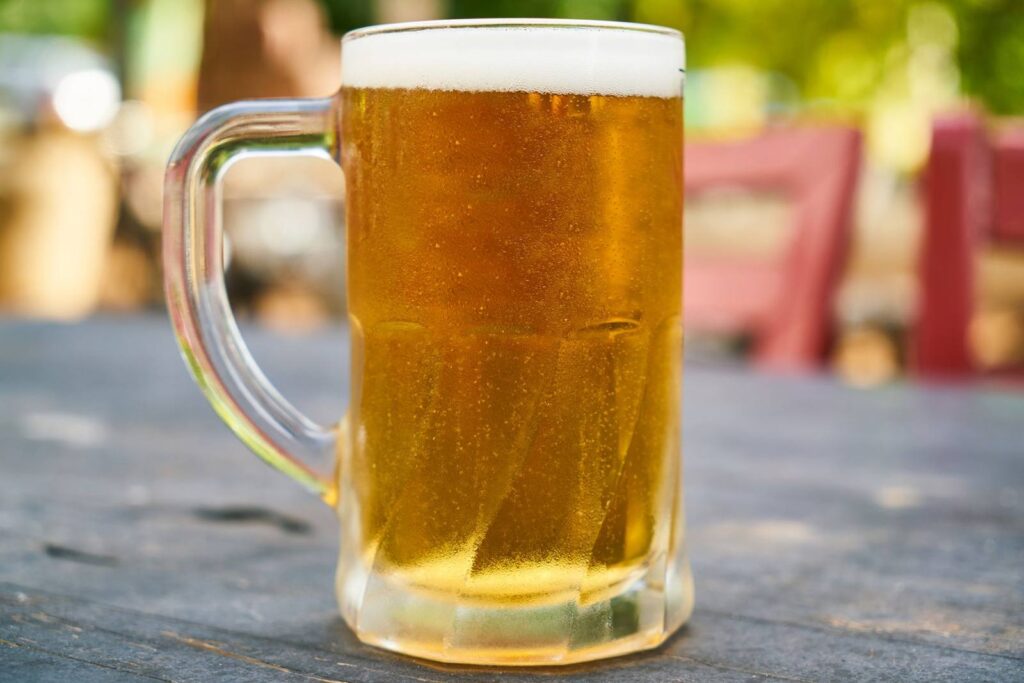
Before we go any further, a confession: I never much cared for beer. My drink at Oktoberfest, and in the beer gardens the rest of the year, was always a Radler — half beer, half lemon soda, which looks exactly like the real thing and lands about half as hard. Consider that my credentials for writing everything below with a straight face.
Order one anyway and somebody at the next table will tell you, unasked, why it tastes the way it does. It will involve a date — 1516 — and a small lecture on yeast, six centuries later still deciding what can legally go in your glass, which six breweries may fill it at Oktoberfest, and even which trees get planted over the beer garden you’re sitting in. This is the drinking half of my Bavarian food guide: the Reinheitsgebot, the styles worth learning, the six Munich breweries, the difference between a beer hall and a beer garden, how big a Maß actually is, how to order one without embarrassing yourself, and where the beer gets more interesting once you leave Munich. Every page in this cluster is linked at the bottom; treat this one as the map before you go wandering. Somewhere in that lecture you will also learn what Bavaria thinks of the rest of the country, which is not much: their word for everyone else is Preißn, Prussians, and the local saying settles it neatly — it’s nice to be a Preiß, but it’s higher to be a Bayer. They still call the place a Free State, they still seem to miss King Ludwig, and they will happily let you believe the cuckoo clock on the wall is theirs too, though it is in fact a Black Forest invention from several hundred kilometers away, a mix-up no Bavarian has ever felt the need to correct.
The Reinheitsgebot: what the 1516 law actually says
It was proclaimed on Georgitag, 23 April 1516, at an assembly of nobility, clergy and town delegates in Ingolstadt, issued jointly by the ruling dukes Wilhelm IV and his younger brother Ludwig X. Its operative line, quoted verbatim by the Bayerischer Brauerbund (the Bavarian Brewers’ Federation), says a beer should use “no more pieces than barley, hops and water.” Yeast never gets a mention, and not because anyone had opinions about it: nobody in 1516 knew that fermentation was yeast’s doing at all. Brewers were already using it. They just didn’t know what “it” was1.
Munich had not waited for a law to worry about this. Augsburg had a beer-quality rule as early as 1156, Nuremberg followed around 1305, Munich in 1363, Regensburg in 1447, and Duke Albrecht IV had already limited Munich’s own brewers to water, malt and hops in a city ordinance dated 30 November 1487, the direct model for the law that came after it1.
The Deutscher Brauer-Bund frames the 1516 law’s real goals as three, and none of them are romantic: keep beer prices from running away, keep wheat out of the brew because the country needed it for bread, and block the henbane, thorn apple and soot that some brewers had been using to stretch a batch2.
Other German states adopted their own versions later, a national Purity Law followed in 1906, and today’s six Oktoberfest breweries still point to both the 1487 Munich ordinance and the 1906 national law as the standard their beer has to clear3.
The six Munich breweries, and what their protected name covers
Only six breweries get to pour at Oktoberfest: Augustiner, Hacker-Pschorr, Hofbräu (properly the Staatliches Hofbräuhaus), Löwenbräu, Paulaner and Spaten. Oktoberfest’s own rule is blunt about it — only beer from “established and reputable traditional Munich breweries” qualifies, measured against both the 1487 Munich law and the 1906 national one3.
Since 2022, the beer poured under that rule has carried its own European Union Protected Geographical Indication: “Oktoberfestbier” may legally be brewed only in Munich, to a registered specification. The City of Munich organizes the festival and does not set the price of that beer, but it does review it “to ensure it is reasonable”19.
Prices vary by brewery and by tent, and muenchen.de keeps a running rundown of what each of the six actually charges if you’d rather compare before you order than after4.
Each of the six has a distinct personality, and each has earned its own page on this site — see Munich’s Big Six Breweries for the full comparison. One fact worth carrying with you before you get there: Hofbräuhaus was founded on 27 September 1589 by Duke Wilhelm V to supply the ducal court, was opened to the public by King Ludwig I in 1828, and registered its “HB” trademark in 187918.
Paulaner, on its own site, traces its Salvator strong beer to 1634, brewed originally by monks to get through their own Lenten fast8.
The styles worth knowing
Munich’s dominant style today, Helles, is a relative latecomer. Spaten’s brewer Gabriel Sedlmayr announced “Helles Lagerbier nach Art des Pilsener Bieres” for sale starting 20 June 1895; Spaten’s own site instead dates the first brew to 21 March 1894, a gap the Bayerischer Brauerbund puts down to “first brewed” versus “first advertised.” A rival brewer complained at the time that a pale beer “damaged Munich’s beer reputation.” Helles won the argument anyway, and it is what most Bavarians order without thinking about it5.
| Style | What it is |
|---|---|
| Helles | Munich’s pale lager, launched by Spaten in 1894–1895 and now the everyday order56 |
| Dunkel | Munich’s dark lager, still in the core range at breweries like Hofbräu and Paulaner78 |
| Weißbier (Hefeweizen) | Cloudy wheat beer; Paulaner calls itself a leading Weissbier brand and also brews a dark Weissbier Dunkel8 |
| Bock / Doppelbock | Strong lager brewed for Lent; Paulaner’s Salvator dates to 1634 and is handed to Bavaria’s minister-president each year at the Nockherberg82122 |
| Märzen / Festbier (Oktoberfestbier) | The Oktoberfest style, an EU-protected name since 2022 that may only be brewed in Munich3 |
| Rauchbier | Smoked beer; Bamberg’s specialty, made with malt dried over an open flame910 |
| Kellerbier | Unfiltered “cellar beer,” a Franconian style served straight from the lagering cellar9 |
| Zoigl | A communal, bottom-fermented specialty from five Upper Palatinate towns, brewed in shared brewhouses since brewing rights were first granted at Falkenberg in 146711 |
Resi says Order the Helles first. It is the most boring name on the list and the only one that actually tells you what Munich drinks on an ordinary Tuesday; a Doppelbock on night one mostly tells you how the ceiling looks from the floor. Save the Bock for when the weather turns, and save the Rauchbier for Bamberg, where it’s made, not shipped in to impress you.
Beer hall or beer garden: the own-food rule
The two are not the same thing, and the difference is not decor. Beer gardens grew out of a nineteenth-century practical problem: brewers needed to keep their bottom-fermented summer beer cold, so they dug cellars, cut ice from frozen lakes each winter, and planted large-leaved shade trees — chiefly limes and chestnuts — over the cellars to slow the ice’s melt. The shaded plots became popular weekend spots, and the brewers started serving beer there directly. What happened next is the part I like: when those same brewers began selling food too, the licensed innkeepers of Munich objected, loudly enough that the authorities struck a compromise that still holds today. Brewers could keep pouring beer at their cellars but were barred from selling food, while their guests were allowed to bring their own — the Brotzeit habit that still marks a genuine Bavarian beer garden16.
A Bavarian tourism page dates the first such license to 1812, granted by King Maximilian I Joseph, and adds the second test of a real Biergarten: it has to be an actual garden under mature trees, not a patio with a few tubs of greenery pretending otherwise17.
A beer hall runs the opposite way, and sells you its own food, full stop. The Hofbräuhaus is the best-known example, open daily from 11:00 to midnight with the kitchen closing at ten and last call at half past eleven, and what’s on the table is what the house decided to cook18.
Resi says Look at the tables before you sit down. A tablecloth and a waitress with a pad mean the service section, which runs on beer-hall rules — no outside food, whatever the leaflet in your bag promised you. Bare wood, no cloth, is self-service, and that is where your own Brotzeit is legal. I sit at the bare tables on principle; food you packed yourself tastes better than food a table decided you should order.
Munich’s other well-known gardens each have their own character. The Königlicher Hirschgarten calls itself the largest beer garden in the world, and its own seating count backs the claim up: roughly 500 seats indoors, 1,200 service seats in the garden, and 7,000 self-service seats where you carry your own tray12.
Chinesischer Turm, in the Englischer Garten, has been run by the Haberl family since 1974 and sources its ox specialties from a farm about 20 km away13.
Augustiner-Keller, tied directly to the Augustiner brewery, still serves its Edelstoff from a wooden barrel14.
Seehaus, on the Kleinhesseloher See, is run by the Kuffler hospitality group, which also operates an Oktoberfest Weinzelt15. My Munich Beer Gardens guide sorts the rest by size and mood, and Munich Beer Garden Rules covers the bring-your-own-food etiquette down to the last picnic blanket.
The Maß, and how to order one
Beer in a Bavarian beer hall or garden is sold by the Maß, a one-liter mug, and every price I have quoted so far, from Oktoberfest’s own beer-price page to the Hirschgarten’s menu, is listed “per liter” — the tell that the liter, not the pint or the half-liter, is the unit that matters here19.
A half-liter, called a Halbe, is usually on the menu too; at the Hirschgarten, a liter of Augustiner Lager runs €8.80 and a half-liter €4.4012.
Ordering could not be simpler. Say the size — “Ein Maß, bitte” for a liter, “Eine Halbe, bitte” for a half — and then wait to see which kind of table you’ve landed at. In the service sections, a waitress brings it and keeps a running tab on a slip of paper by your glass; at the self-service counters, you queue, pay, and carry your own tray to a bare wooden table. My How to Order a Beer in Bavaria page covers what doesn’t fit here: the tip, the Stammtisch, and the Noagerl, which is what Bavarians call the last, undrunk mouthful nobody quite finishes.
Beer towns beyond Munich
Bamberg. An hour or so northeast by train, Bamberg is a UNESCO World Heritage old town — one of the largest preserved historic centers in Europe, with more than 2,400 protected buildings — built on brewing rather than in spite of it. Eleven family-run breweries operate inside the city alone, and 60 more across the wider Bamberg region turn out some 400 different beers between them, none of it from a mass producer. The city counts 25 beer cellars with their own beer gardens, and its Rauchbier, Bockbier and Franconian Kellerbier are all made here rather than shipped in9. My Bamberg’s Smoked Beer guide covers getting there and where to drink it.
Franconia. Zoom out from Bamberg and you’re in Franconia, where Bavaria’s own tourism board says brewery density in Upper Franconia “is unique in the world” — a claim the state’s own brewery statistics back up, since Oberfranken alone has 170 of Bavaria’s 622 breweries, more than any other district10. Kulmbach, in the same region, calls itself the “Secret Capital of Beer” and runs its own Beer Week and brewery museum.
Further east, in the Upper Palatinate, five towns — Mitterteich, Falkenberg, Neuhaus, Windischeschenbach and Eslarn — still brew Zoigl the communal way, eighteen private brewers sharing protected town brewhouses under a system whose brewing rights go back to 1467 at Falkenberg; the style has been on Bavaria’s intangible cultural heritage list since 201811. My Franconia’s Beer Country guide has the full breakdown of Kellerbier, Zoigl and the towns to base yourself in.
Andechs. South of Munich, the hilltop monastery brewery at Andechs is one of Bavaria’s best-known beer garden day trips, and I’m not going to hand you a founding date or a “still run by monks” claim I can’t back with a source on this site’s approved list, so I’m leaving the specifics to the dedicated page rather than guessing. What I can tell you now: it’s a working monastery brewery with a beer garden on the hill, and it comes up constantly in the same breath as Weihenstephan below. See Andechs from Munich once we’ve confirmed the rest against the monastery’s own material.
Weihenstephan. The other name that comes up in that same conversation, usually attached to a claim of being the world’s oldest brewery. Weihenstephaner makes that claim for itself, and Kloster Weltenburg, a monastery brewery on the Danube near Kelheim, makes a competing claim to be the world’s oldest monastery brewery — Weltenburg’s own hospitality material describes its Barock Dunkel and Weltenburger Asam Bock, exported to more than twenty countries, without giving a founding date to back the claim up25. My Weihenstephan, Weltenburg and the Oldest Brewery Question page lays out what each side actually says.
Resi says I am not refereeing the “oldest brewery” argument, and neither should you; two sets of monks have had centuries to settle it and have chosen not to. Both places make good beer today, which was never actually in dispute. Order the Dunkel at whichever one you reach first and leave the paperwork to them.
The festivals
Oktoberfest is the big one, and it has its own pillar on this site. Beyond it:
- Starkbierfest at Nockherberg (Paulaner am Nockherberg, Munich): next edition 26 February–21 March 2027, built around Salvator Doppelbock and the ceremonial handover of the first liter to Bavaria’s minister-president21.
- Annafest, Forchheim: the 2026 edition runs 25 July–3 August in the Forchheimer Kellerwald, the town’s historic beer-and-wine cellar forest, with a published “Kellerplan” tracking which cellars are open23.
- Gäubodenvolksfest, Straubing: founded in 1812 when King Maximilian I Joseph granted the town permission for an agricultural festival; billed as Bavaria’s second-largest Volksfest, with about 1.3 million visitors a year and, for the 2027 edition (13–23 August), 27,500 seats across seven tents24.
My Bavaria’s Other Beer Festivals page covers the rest, including the ones I could confirm only through non-official sources and flagged as such.
Guides in this section
- Beer Hall or Beer Garden?
- How Big Is a Maß?
- Is the Hofbräuhaus Worth It?
- The Reinheitsgebot Explained
- Helles vs Pilsner
- Weißbier: Bavaria’s Wheat Beer
- German Hefeweizens Worth Seeking Out
- Munich Beer Garden Rules
- Bavarian Beer Styles Explained
- Munich’s Big Six Breweries
- Munich Beer Gardens
- Munich Beer Halls Beyond the Hofbräuhaus
- What Is Oktoberfest Beer?
- How to Order a Beer in Bavaria
- Bavarian Beer Glasses
- Andechs from Munich
- Radler vs Shandy
- Bamberg’s Smoked Beer
- Starkbierzeit
- Munich Beer Tours Compared
- Weihenstephan, Weltenburg and the Oldest Brewery Question
- Franconia’s Beer Country
- Bavarian Beer in the US and Canada
- Bavaria’s Other Beer Festivals
- Drinking Age and Beer Laws in Germany
Frequently Asked Questions
How much is a Maß of beer at Oktoberfest?
For the 2026 festival, expect €14.80 to €15.90 per liter, about 2.4 percent higher than 2025. The Weinzelt, which pours only wheat beer, charges more, at €18.40.
Which breweries are allowed to serve beer at Oktoberfest?
Six: Augustiner, Hacker-Pschorr, Hofbräu, Löwenbräu, Paulaner and Spaten, measured against both the 1487 Munich law and the 1906 German one.
How old is the Reinheitsgebot, and is it still in force?
It dates to 23 April 1516, and the Bayerischer Brauerbund calls it the world’s oldest still-valid food-law regulation. I’d call that a fair boast, for once.
Can you bring your own food into a Bavarian beer garden?
At a genuine Biergarten, yes. The custom traces to a nineteenth-century compromise that let brewers keep selling beer at their cellars but barred them from selling food, so guests started bringing their own, and never stopped.
How many breweries are there in Bavaria?
622 operating brewing sites, by the Bayerischer Brauerbund’s own count, which works out to roughly one for every 21,500 residents.
What is the largest beer garden in the world?
The Königlicher Hirschgarten makes that claim, citing about 500 indoor seats, 1,200 outdoor service seats and 7,000 self-service seats. I have no reason to argue with a venue that seats 8,700 people at once.
How much beer is drunk at Oktoberfest every year?
Between 6 and 7 million liters, by the festival’s own count.
Is Weihenstephan really the oldest brewery in the world?
Weihenstephaner makes that claim, and Kloster Weltenburg claims to be the oldest monastery brewery instead. I haven’t found a source I trust that settles it, so I’m reporting the argument rather than picking a side.
Related Articles
Sources
- Reinheitsgebot: Geschichte und Bedeutung — Bayerischer Brauerbund (bayerisches-bier.de). Accessed 2026-09-24.
- Reinheitsgebot: Entstehung — Deutscher Brauer-Bund. Accessed 2026-09-24.
- The Six Munich Breweries at Oktoberfest — Oktoberfest.de, City of Munich. Accessed 2026-09-24.
- Beer Prices 2026: The Breweries — muenchen.de, City of Munich. Accessed 2026-09-24.
- Eisgalgen — Bayerischer Brauerbund (bayerisches-bier.de). Accessed 2026-09-24.
- Spaten — Spatenbrauerei. Accessed 2026-09-24.
- Hofbräuhaus — Staatliches Hofbräuhaus München. Accessed 2026-09-24.
- Paulaner — Paulaner Brauerei. Accessed 2026-09-24.
- Citycheck Bamberg — Bavaria Tourism Board (bavaria.travel). Accessed 2026-09-24.
- Guide: Franconia — Bavaria Tourism Board (bavaria.travel). Accessed 2026-09-24.
- Zoigl Beer Hiking in Eastern Bavaria — Bavaria Tourism Board (bavaria.travel). Accessed 2026-09-24.
- Königlicher Hirschgarten — Hirschgarten. Accessed 2026-09-24.
- Chinesischer Turm — Chinesischer Turm. Accessed 2026-09-24.
- Augustiner-Keller — Augustiner-Keller. Accessed 2026-09-24.
- Kuffler — Kuffler Hospitality Group. Accessed 2026-09-24.
- Biergärten — Bayerischer Brauerbund (bayerisches-bier.de). Accessed 2026-09-24.
- The Beer Garden Tradition — Bavaria Tourism Board (bavaria.travel). Accessed 2026-09-24.
- Hofbräuhaus History — Staatliches Hofbräuhaus München. Accessed 2026-09-24.
- Beer Price — Oktoberfest.de, City of Munich. Accessed 2026-09-24.
- Die Brauereien — Bayerischer Brauerbund (bayerisches-bier.de). Accessed 2026-09-24.
- Starkbierfest — Paulaner am Nockherberg. Accessed 2026-09-24.
- Salvator — Paulaner Brauerei. Accessed 2026-09-24.
- Annafest — Annafest Forchheim. Accessed 2026-09-24.
- Gäubodenvolksfest — Ausstellungs-GmbH Straubing. Accessed 2026-09-24.
- Kloster Weltenburg Abbey St. Georg — Bavaria Tourism Board (bavaria.travel). Accessed 2026-09-24.