In brief
A day of Bavarian eating runs on a short list of dishes: Weißwurst, Brezn, Obatzda, Leberkäse, Schweinshaxe, Schweinebraten and a half-dozen kinds of Knödel, repeated across breakfast, Brotzeit and the midday roast. Four of those names carry formal European Union protection — Bayerische Breze, Obazda, Nürnberger Rostbratwürste and, for the wider region, Schwäbische Spätzle — which fixes what can legally be sold under them. Not everything on a Bavarian menu is actually Bavarian: Munich’s own tourism site credits Kaiserschmarrn and Apfelstrudel to Austria. Beer gardens run on a nineteenth-century rule that lets you bring your own Brotzeit instead of buying the venue’s food. Most of what makes this cooking Bavarian ships to North America by mail order, sweet mustard and frozen Weißwurst included.
Disclosure: some links on this page are affiliate links, marked by the products and tours they name. As an Amazon Associate, bavarianbistro.com earns from qualifying purchases. A purchase through these links may earn the site a commission at no cost to you, and it never affects what is recommended. How this works.
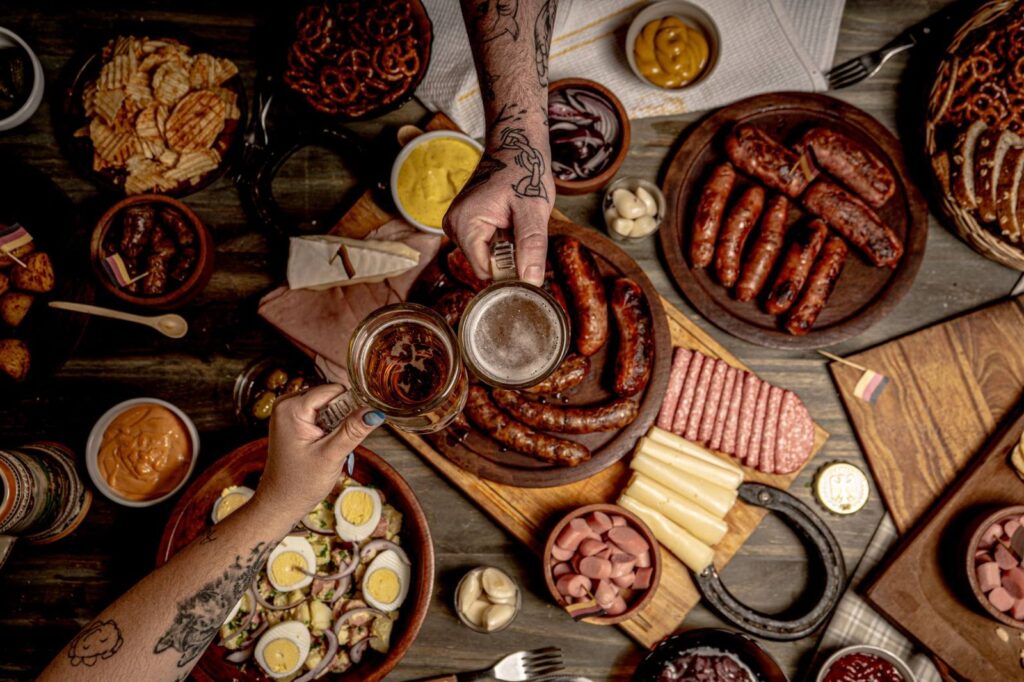
If you’re picturing Bavarian food as a bowl of pale sausages in hot water, that’s fair, and it’s also not what I’d order. My own favorites are the Rostbratwürstl, small fried pork sausages about the size of a finger, and the Wienerle; alongside them I’d take an Obatzda, a warm potato salad and a fresh Brezn over almost anything else on this table. Weißwurst gets its own page on this site, appropriately enough, and I’ve eaten plenty of it. It has just never once been the thing I ordered for myself.
This is the eating half of my Bavarian beer guide — the dishes worth knowing, which ones are genuinely Bavarian and which just live on the same menu, the handful of names the European Union actually protects, and what a North American kitchen can get its hands on. Every dish gets its own page, linked below; this is where you start. Bavarians, for what it’s worth, have a fairly settled opinion of themselves next to the rest of the country: their word for everyone else is Preißn, Prussians, and the local saying puts it plainly — it’s nice to be a Preiß, but it’s higher to be a Bayer. They still call the place a Free State, and as far as I can tell, they still miss King Ludwig.
A day in Bavarian meals
For anyone still keeping the old custom, breakfast starts with Weißwurst, a pale, poached sausage of veal and pork belly, and Munich has a name for the whole late-morning meal that goes with it — sweet mustard, a pretzel, a wheat beer and all — Frühschoppen2.
Munich’s own specialties register dates the sausage itself to 22 February 1857, at an inn on Marienplatz, though the register admits a historian found an 1814 engraving of people eating white sausages 43 years earlier. I take the earlier date, and the shrug that comes with it1.
Brotzeit, literally “bread time,” is what fills the rest of the day. The state’s own culinary register frames it around Radi, a raw, thinly sliced radish eaten, in its words, “gern zur Brezn,” gladly alongside a pretzel3.
Munich’s tourism content lists a full Brotzeitplatte as sausages, ham, cheese, radishes, pickles and sometimes Presssack, a cold cut made from what’s left once the sausage is done4.
The midday roast, when there’s time for one, is usually Schweinebraten: shoulder, neck or ham, seasoned with salt, pepper and caraway, roasted until the register’s own requirement is met — the skin must be crispy — and served with a dark-beer gravy9.
Then there’s the beer garden plate, which is really Brotzeit moved outdoors: the same cold cuts and radishes, except now you may have carried them in yourself. More on why below.
The 15 dishes worth knowing
Here is the table I’d hand a first-time visitor, the dishes that actually define this table rather than the ones that just show up on it:
| Dish | What it is |
|---|---|
| Weißwurst | Poached veal-and-pork sausage, traditionally eaten before noon with sweet mustard and a pretzel1 |
| Brezn (Bavarian pretzel) | Lye-dipped pretzel with a “deep-glazed, copper-coloured crust,” EU-protected since 20145 |
| Obatzda | A spread built on ripe Camembert or Brie, EU-protected since 20156 |
| Leberkäse | A baked loaf of beef, pork and fat — no liver, despite the name7 |
| Schweinshaxe | Roasted pork knuckle, seasoned with just salt, pepper and garlic8 |
| Schweinebraten | The midday pork roast, crackling skin required, dark-beer gravy9 |
| Knödel | Bread or potato dumplings, found in all seven Bavarian districts10 |
| Nürnberger Rostbratwurst | Finger-sized, marjoram-forward sausage, EU-protected since July 200311 |
| Hendl | Half a grilled or spit-roasted chicken, a beer-garden and Oktoberfest staple4 |
| Kaiserschmarrn | Torn pancake with raisins and applesauce; Munich’s own tourism site calls it Austrian4 |
| Apfelstrudel | Stretched-pastry apple strudel, on every Bavarian menu though its roots are Austrian too4 |
| Dampfnudel | A steamed yeast dumpling, served in vanilla sauce4 |
| Kässpätzle | Egg noodles baked with Emmentaler and topped with roasted onions4 |
| Zwetschgendatschi | A plum sheet cake baked only when late-summer plums are in season20 |
| Prinzregententorte | An eight-layer chocolate cake named for a Bavarian regent21 |
Source:1,4,5,6,7,8,9,10,11,20,21.
Resi says A Leberkäs Semmel with sweet mustard was my go-to on errand runs — Munich’s original fast food, and I don’t say that loosely. “No liver in Leberkäse” isn’t a marketing line either: it’s the Bavarian government’s own register making the point in writing, because versions made outside Bavaria sometimes do contain liver. Order it the way Munich does: in a roll, with sweet mustard, standing up at the counter.
How Munich actually serves these dishes
A few of the entries above need a word on how they actually show up on the plate, because the name alone undersells the custom around them.
Leberkäse is baked, not fried, at 160 to 200°C until the crispy end piece — the register calls it the Scherzel — is ready to cut. Most people never eat it any other way than a Leberkässemmel, a slice tucked into a bread roll with sweet or medium-hot mustard, sold from bakery counters and butcher windows as a between-meals sandwich rather than a sit-down dish7.
Hendl, the beer garden’s roast chicken, is grilled or spit-roasted and served by the half, typically with potato salad, fries or a pretzel on the side. It is one of the few dishes here that reads exactly the same to a Bavarian and to a visitor4.
Wurstsalat, a cold sausage salad built on sliced Lyoner or Regensburger sausage dressed with onions, vinegar and oil, is a Brotzeit regular that rarely earns its own line on the menu but shows up on nearly every one anyway4.
At the beer garden specifically, Steckerlfisch — whitefish, trout, mackerel or char, grilled whole on a stick over open coals — is the other roast worth ordering, and it is common enough at Oktoberfest that most visitors meet it there before they meet it anywhere else4.
Knödel gets a second life once the meal is over. The register notes that leftover dumplings are typically sliced and pan-fried until crisp, sometimes topped with a fried egg and served alongside a salad, a use-it-up habit that turns yesterday’s side dish into today’s lunch10.
Schweinshaxe has a cured cousin worth knowing too: Surhaxe, a pickled version of the same cut, which is a different preparation entirely from the roasted, crackling-skinned Schweinshaxe on most beer hall menus8.
Not every dessert on this list is borrowed from somewhere else. Bayerische Creme — milk, egg yolk, sugar, whipped cream and gelatin, set into a mold — is Bavarian by Munich’s own account, described on the city’s tourism site as “the lightest dish of the desserts,” meant to follow a heavier meal4. My Bavarian Desserts page covers it alongside Kaiserschmarrn, Dampfnudel and the rest, borrowed or not.
What's Bavarian, and what just lives on the same menu
Not everything on a Munich menu is Bavarian, and the state’s own tourism content doesn’t pretend otherwise. Kaiserschmarrn, the torn pancake with raisins, “originated in Austria,” per Munich’s own city tourism site, sitting on the very same list as genuinely Bavarian dishes like Schweinebraten and Hendl4. Apfelstrudel has the same story: it is everywhere in Bavaria, and it is Austrian all the same.
Resi says Kaiserschmarrn and Apfelstrudel are Austrian, whatever the menu implies, and I’d include Wiener Schnitzel in that complaint even though it isn’t Bavarian either. None of this stops me from ordering all three; a good torn pancake does not check passports. Non-Germans make the opposite mistake constantly, filing Trachten, Neuschwanstein and the cuckoo clock on the wall all under “Bavaria.” Two of those are. The cuckoo clock is a Black Forest export, several hundred kilometers off, and no Bavarian has ever felt the need to correct the record.
Spätzle sits in a stranger spot. The European Union’s own register protects “Schwäbische Spätzle / Schwäbische Knöpfle” as a Protected Geographical Indication for Germany’s Swabian region, a designation that stops at the Bavarian border rather than crossing it12. Bavarians eat plenty of Spätzle anyway, especially Kässpätzle in the Allgäu, but the legal name belongs to Swabia. My Spätzle: Swabian by Law, Bavarian by Appetite page has the full account.
Rouladen — beef rolled around bacon, onion, mustard and a pickle, then braised — is a nationwide German dish rather than a Bavarian one. The name comes from the French “roulade,” picked up by German kitchens in the eighteenth and nineteenth centuries, and the dish has its own named regional variants elsewhere in the country, including a sweet-sour Rhineland version and a cabbage-wrapped one18. Sauerbraten shows up on the same Bavarian menus, and my Sauerbraten page traces where its roots actually point. Wiener Schnitzel is the clearest case of all: the name says Vienna, and it belongs there, whatever a Bavarian Gasthaus menu implies; see my Wiener Schnitzel FAQ for the rest.
The EU-protected names
Four Bavarian-food names carry formal European Union protection, which means only products meeting a registered specification can legally use them:
- Bayerische Breze (the Bavarian pretzel), entered as a Protected Geographical Indication on 18 February 2014, specification held in the EU’s own legal register5.
- Obazda / Obatzter, registered as a Protected Geographical Indication on 16 June 2015, unopposed during the standard objection period6.
- Nürnberger Rostbratwürste, protected since July 2003 under the Bavarian specialties register’s own account, though the bare word “Rostbratwürste” without “Nürnberger” is not itself protected11.
- Schwäbische Spätzle / Schwäbische Knöpfle, protected since 2012 — a Swabian name, not a Bavarian one, and a useful reminder that “on a Bavarian menu” and “legally Bavarian” are different tests12.
Beer has a protected name in the same family: “Oktoberfestbier” has carried EU Protected Geographical Indication status since 2022, restricted to beer brewed in Munich, and I cover it in full in my Bavarian beer guide.
Legal protection isn’t the only kind of recognition a dish can earn. Slow Food Germany keeps a separate, informal register called the Ark of Taste, for foods judged at risk of disappearing, with a genuine flavor and a real regional history, each entry checked by two independent experts before it is listed. Bavaria accounts for 29 of the 92 entries nationally, by the state’s own culinary register’s count19.
None of the dishes on this page’s table happen to be among the four Ark passengers Munich’s own Slow Food chapter lists on its site — a cattle breed, a wheat variety, a bread roll and a cabbage variety, not a sausage or a dumpling among them22. The foods worth protecting and the foods worth eating on a Tuesday, it turns out, are not always the same list.
The beer-garden own-food rule
Bavaria’s beer gardens run on a custom older than any modern food-and-beverage regulation. A Bavarian tourism page traces it to the nineteenth century: brewers who dug cellars and planted chestnut trees to keep their summer beer cold began serving it on-site, and when they also started selling food, the licensed innkeepers of the day objected. The compromise barred brewers from selling food but let guests bring their own, which is why a genuine Biergarten still needs two things: you may bring your own food, and it has to be an actual garden under mature trees, not a patio with a few planters. The same page dates the first such license to 1812, granted by King Maximilian I Joseph13.
The Viktualienmarkt’s own beer garden confirms the same rule in practice today: bring your own food, buy your own drink14.
That is a genuine Biergarten, not a Wirtsgarten, where only the house’s own food is sold, a distinction worth knowing before you unpack a picnic somewhere that doesn’t allow it. My Munich Beer Garden Rules page, on the beer side of the site, covers exactly where the line falls.
Cooking Bavarian in North America
Most of what makes this food Bavarian travels reasonably well. Weißwurst is sold frozen and pre-cooked by mail order — a starter kit from the German-food importer The Taste of Germany bundles two packs of Weißwurst, ten pretzels and a jar of sweet mustard for $48.95, as of September 2026, shipped in two to three days because a fresh sausage cannot travel slowly15.
The mustard is the easiest single ingredient to source on its own: Händlmaier‘s sweet Bavarian mustard, the Regensburg brand that shows up on nearly every Bavarian table, comes in a 13.4-ounce jar on Amazon in the US16.
For Spätzle and Kässpätzle, a dedicated press makes the dough manageable at home, and Amazon carries German-made options, including a Goldspatz press built for round noodles17.
Resi says The Händlmaier’s isn’t a recommendation I’m making at arm’s length: it’s so good I could eat it by itself, and it’s always a hit when I bring a jar camping. Nothing compares. After I moved to the US I missed this food badly, until Aldi started carrying its own “Deutsche Küche” range here — frozen strudels, bratwursts, sweet mustard, black sunflower-seed bread, absolutely the real deal, though it only shows up once or twice a year, so I stock up the moment it does. If you’re building the pantry from scratch, mail order is the steadier route: start with the Händlmaier’s and the Weißwurst kit, in that order, since the mustard has no real substitute and the sausage is the one dish worth the shipping cost. The Goldspatz press is worth adding once you’re making Spätzle more than once a season.
None of this is a substitute for the full pantry. My Cooking Bavarian in North America pillar covers the tools, the ingredient swaps and the mail-order grocers in depth; start there once this page has told you what to look for.
Guides in this section
- Weißwurst: How to Eat Bavaria’s White Sausage
- What Is Leberkäse?
- Obatzda
- Real Bavarian Pretzels at Home
- Brotzeit Explained
- The Bavarian Breakfast
- How to Read a Bavarian Menu
- Schweinshaxe
- Schweinebraten
- Knödel
- Nürnberger Rostbratwurst
- Bratwurst in Bavaria
- Bratwurst vs Knockwurst
- Wiener Schnitzel FAQ
- Wiener Schnitzel vs Jägerschnitzel
- Jäger Sauce
- Bratkartoffeln
- Kaiserschmarrn
- Apfelstrudel: Bavarian vs Austrian
- Bavarian Potato Salad
- Sauerkraut vs Bayrisch Kraut
- Dampfnudel
- Steckerlfisch
- Wiesn Hendl
- Kässpatzle: The Allgäu’s Cheese Noodles
- Spätzle: Swabian by Law, Bavarian by Appetite
- Zwetschgendatschi
- Browning Meat
- Rouladen
- Chef Keem’s Bavarian Bistro Recipes
- Bavarian vs German Food
- The Bavarian Foods with EU Protection
- German Sausages, Sorted
- Prinzregententorte
- Auszogne and Schmalznudel
- Sauerbraten
- Bavarian Desserts
- Bavarian Sweet Mustard
Frequently Asked Questions
Is Kaiserschmarrn a Bavarian dish or an Austrian one?
Austrian. Munich’s own city tourism site lists it as having originated in Austria, even though it appears on Bavarian dessert menus everywhere.
Does Bavarian Leberkäse actually have liver in it?
No. The Bavarian government’s culinary register states plainly that there is no liver in Bavarian Leberkäse, unlike some versions made outside Bavaria.
Is Obazda the same as Obatzter?
Yes. The EU’s registration for the Protected Geographical Indication uses both names, “Obazda” and “Obatzter,” for the same spread.
Is the Bavarian pretzel actually protected by EU law?
Yes. “Bayerische Breze” has been registered as a Protected Geographical Indication since 18 February 2014.
Is Spätzle a protected name, and does that cover Bavaria?
The protected name is “Schwäbische Spätzle / Schwäbische Knöpfle,” registered in 2012 and tied to Swabia, not Bavaria as a whole, even though Bavarians eat plenty of it.
Can you really bring your own food into a Bavarian beer garden?
At a genuine Biergarten, yes. The custom dates to a nineteenth-century rule that let brewers keep pouring beer at their cellars but barred them from selling food, so guests brought their own.
Is Rouladen actually a Bavarian dish?
Not originally. Rouladen is found nationwide in Germany, with its own named regional variants elsewhere in the country; it is on Bavarian menus by adoption, not by origin.
How many Bavarian foods are on Slow Food's Ark of Taste?
29, out of 92 nationally, by the Bavarian specialties register’s own count.
Related Articles
Sources
- Münchner Weißwurst — Genussorte Bayern, Bavarian State Ministry of Food, Agriculture and Forestry. Accessed 2026-09-24.
- Frühschoppen — Munich Beer Gardens. Accessed 2026-09-24.
- Radi — Genussorte Bayern. Accessed 2026-09-24.
- Bavarian Cuisine: These Dishes Have Tradition — muenchen.de, City of Munich. Accessed 2026-09-24.
- Bayerische Breze / Bayerische Brezn — EUR-Lex, European Union. Accessed 2026-09-24.
- Commission Implementing Regulation (EU) 2015/1002 — EUR-Lex, European Union. Accessed 2026-09-24.
- Bayerischer Leberkäse — Genussorte Bayern. Accessed 2026-09-24.
- Schweinshaxe — Genussorte Bayern. Accessed 2026-09-24.
- Schweinebraten — Genussorte Bayern. Accessed 2026-09-24.
- Semmelknödel — Genussorte Bayern. Accessed 2026-09-24.
- Nürnberger Rostbratwürste — Genussorte Bayern. Accessed 2026-09-24.
- Commission Implementing Regulation (EU) No 186/2012 — EUR-Lex, European Union. Accessed 2026-09-24.
- The Beer Garden Tradition — Bavaria Tourism Board (bavaria.travel). Accessed 2026-09-24.
- Viktualienmarkt — muenchen.de, City of Munich. Accessed 2026-09-24.
- The Taste of Germany Weisswurst & Pretzel Meal Kit — The Taste of Germany. Accessed 2026-09-24.
- Händlmaier’s Sweet Bavarian Mustard, 13.4 oz — Amazon.com. Accessed 2026-09-24.
- Goldspatz Spaetzle Maker & Potato Press — Amazon.com. Accessed 2026-09-24.
- Everything You Need to Know About Rouladen — Germany Footsteps. Accessed 2026-09-24.
- Ark of Taste — Genussorte Bayern. Accessed 2026-09-24.
- Zwetschgendatschi — Genussorte Bayern. Accessed 2026-09-24.
- Prinzregententorte — Genussorte Bayern. Accessed 2026-09-24.
- Arche des Geschmacks — Slow Food München. Accessed 2026-09-24.